Choose what the owner is responsible for. You can combine both options.
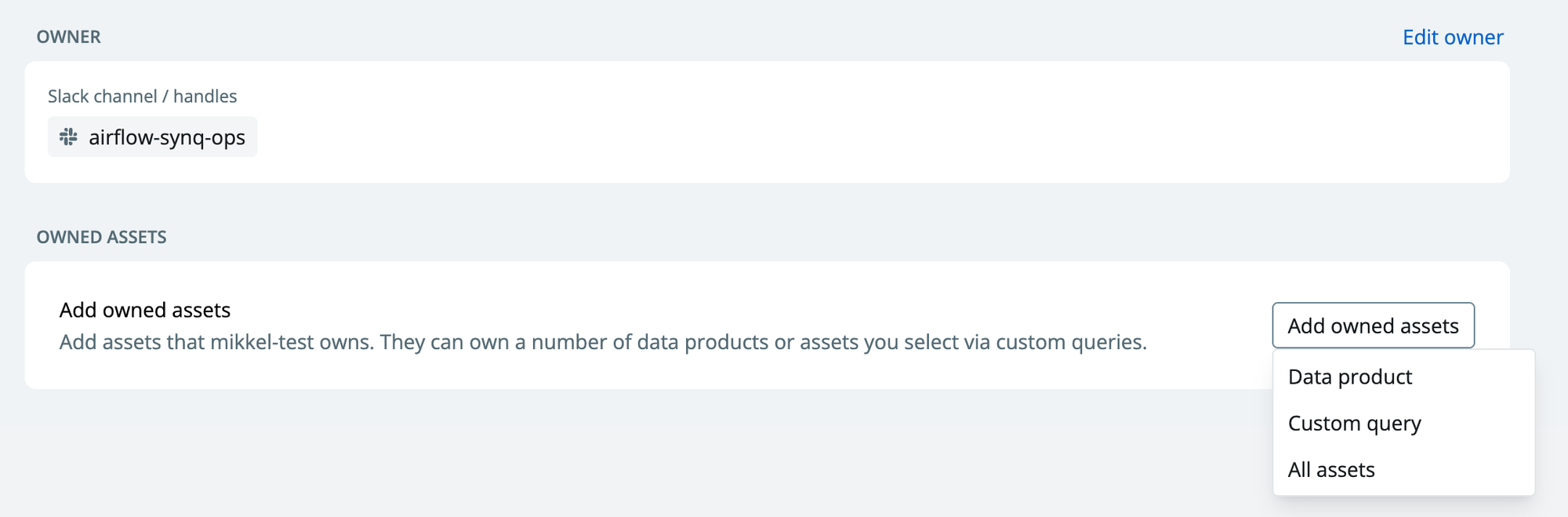
Products: select one or more data products. A data product has one owner. If a product you select already has an owner, the wizard warns you, and the previous owner stops receiving alerts for it.
Assets: select assets with filters, or turn on Own all assets to make the owner responsible for every asset in the workspace (e.g., for a data team owner).
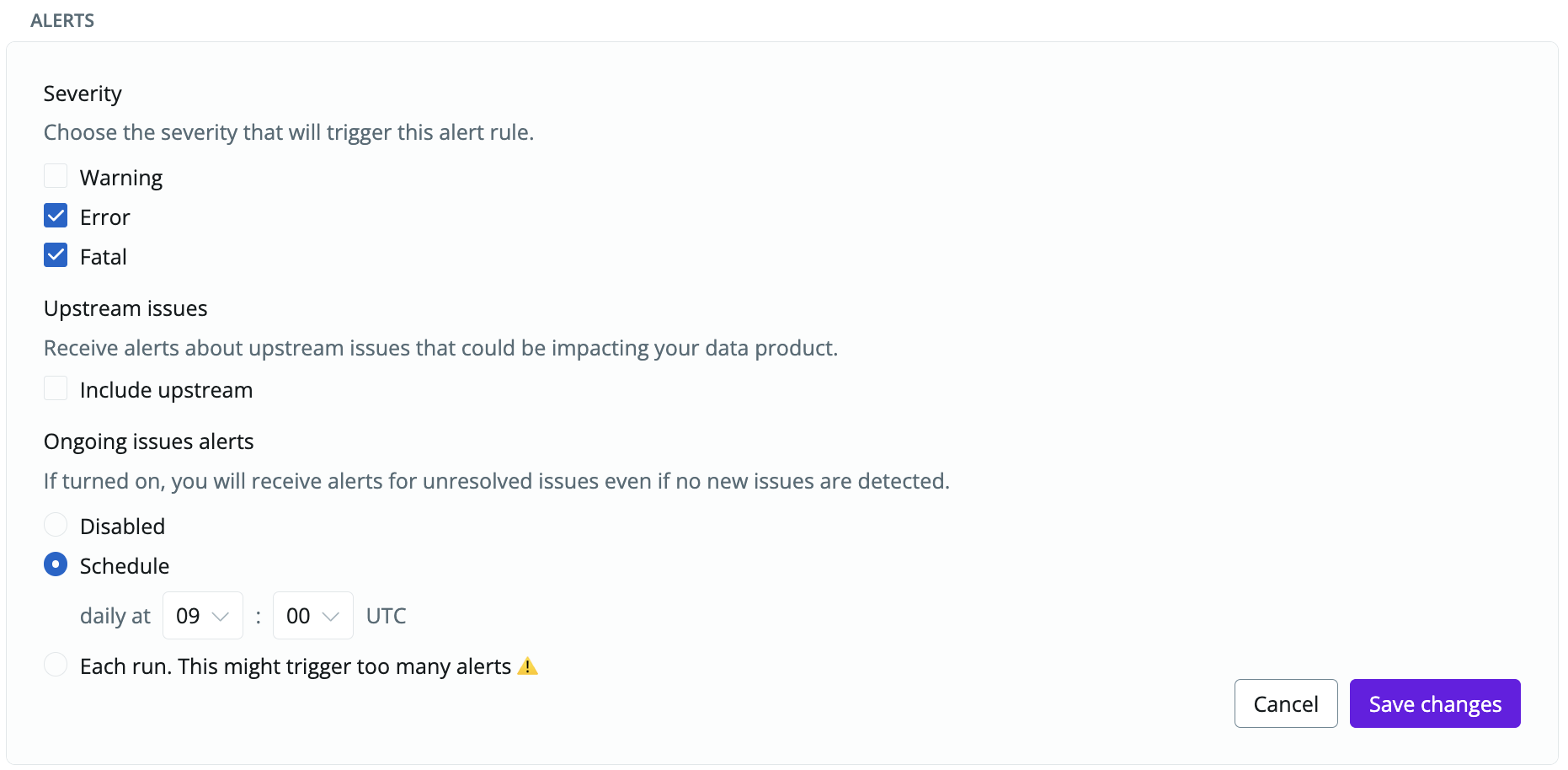
Turn on Add an issue alert for this owner's assets to notify the owner about issues on everything it owns, including assets added later. The alert goes to the owner’s contacts from the Details step, unless you pick other targets.
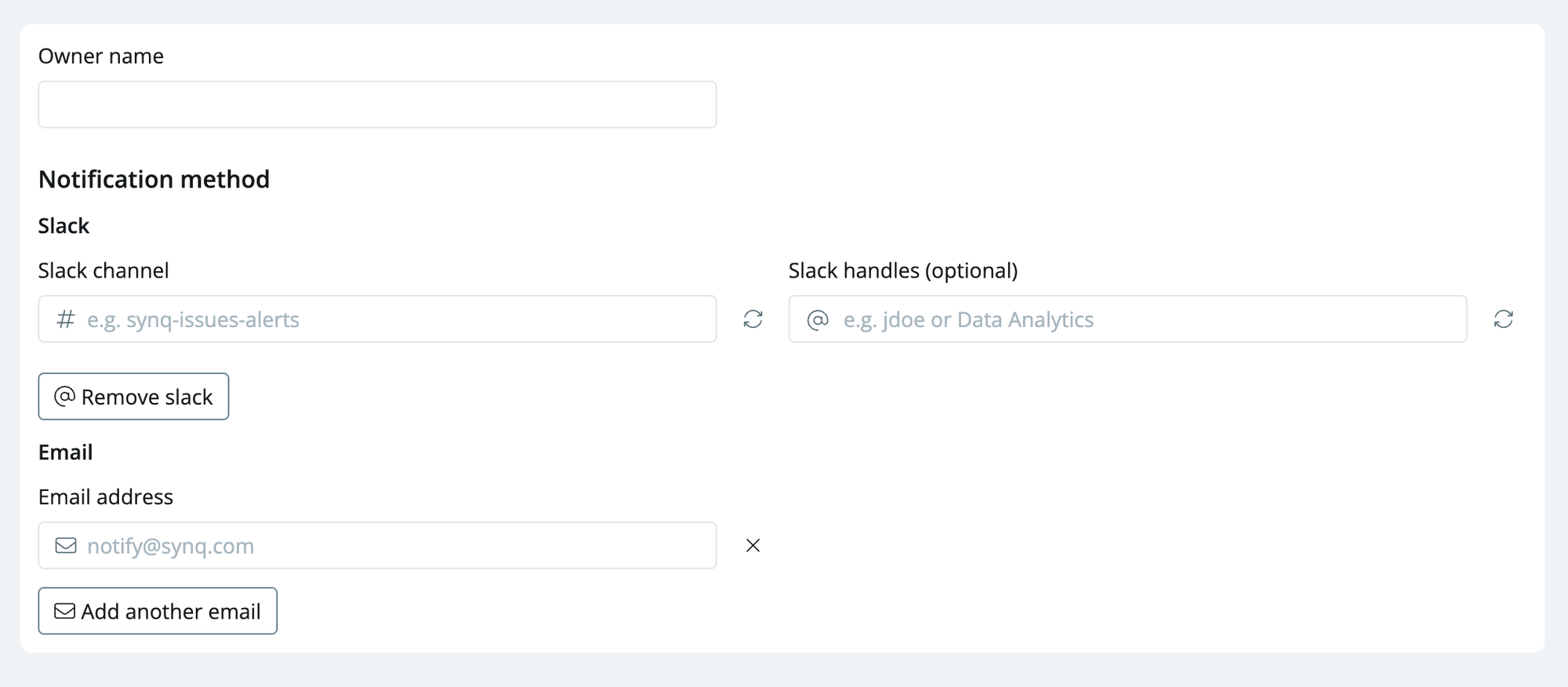
You can read and change an owner, its notification channels and the alert configuration of its ownerships outside the app. This helps when you review or change alert routing in bulk.
Public API: synq.owners.v1.OwnersService covers owners, their contacts
and their ownerships. Reading needs a token with SCOPE_OWNERS_READ and
SCOPE_OWNERSHIP_READ; writing needs SCOPE_OWNERS_EDIT and
SCOPE_OWNERSHIP_EDIT. See the API reference and API scopes.
MCP: the owner tools create or update
an owner and the assets it is responsible for in one call, including the
severities and channels its alerts go to. Reading is covered by read-only
consent; writing needs the Governance permission and is
confirmation-gated.
{"docsConfig":{"theme":"mint","$schema":"https://mintlify.com/docs.json","name":"Coalesce Quality Documentation","colors":{"primary":"#135594","light":"#e8f0f8","dark":"#0d3966"},"logo":{"light":"https://mintcdn.com/synq-15/VrNXC6Gv5xCECUGd/logo/coalesce-quality-logo.svg?fit=max\u0026auto=format\u0026n=VrNXC6Gv5xCECUGd\u0026q=85\u0026s=4ad60b616ed815902c710f413d59cf63","dark":"https://mintcdn.com/synq-15/VrNXC6Gv5xCECUGd/logo/coalesce-quality-logo-white.svg?fit=max\u0026auto=format\u0026n=VrNXC6Gv5xCECUGd\u0026q=85\u0026s=4d8c4a954595c0dfd25bfdf645e6cb56"},"favicon":{"light":"https://mintcdn.com/synq-15/xb0Db-MnOw_Ojah5/favicon.svg?fit=max\u0026auto=format\u0026n=xb0Db-MnOw_Ojah5\u0026q=85\u0026s=860c7081b896f01fe24af1c330da1796","dark":"https://mintcdn.com/synq-15/qs0RRq4z_2GWyKyp/favicon-dark.svg?fit=max\u0026auto=format\u0026n=qs0RRq4z_2GWyKyp\u0026q=85\u0026s=b740f42e7f6972f91d62be5b2840c805"},"navbar":{"links":[{"href":"https://coalesce.io/product/quality/","label":"Website"},{"href":"https://coalesce.io/product/request-demo/","label":"Book a Demo"}],"primary":{"type":"button","label":"Coalesce Quality Platform","href":"https://app.synq.io"}},"footer":{"socials":{"linkedin":"https://www.linkedin.com/company/coalesceio"}},"integrations":{"ga4":{"measurementId":"G-P55J2JTKF1"}},"styling":{"latex":false},"navigation":{"global":{"anchors":[{"anchor":"Blog","icon":"newspaper","href":"https://coalesce.io/resources/"},{"anchor":"Changelog","icon":"rocket","href":"https://synq.io/changelog"}]},"pages":[]}},"deployment":{"deploymentMetadataValue":{"subdomain":"synq-15","hasAudioNarration":false,"actualSubdomain":"synq-15","customDomains":["docs.synq.io"],"gitSource":{"type":"github","owner":"getsynq","repo":"docs","deployBranch":"master","contentDirectory":"","isPrivate":false,"mountPath":"","label":""},"entitlements":{"AI_CHAT":{"status":"DISABLED"}},"buildId":"6af487838d8c3673421f4d1e","clientVersion":"0.0.4111","searchFilterCounts":[{"language":"default","tag":"Documentation","count":451},{"language":"default","tag":"Developer API","count":343},{"language":"default","tag":"REST API","count":332},{"language":"default","tag":"synq.incidents.v1.IncidentsService","count":14},{"language":"default","tag":"Monitors","count":13},{"language":"default","tag":"Reconciliations","count":13},{"language":"default","tag":"synq.alerts.services.v2.AlertsService","count":13},{"language":"default","tag":"synq.monitors.automated_monitors.v1.DeploymentRulesService","count":12},{"language":"default","tag":"synq.domains.v2.DomainsService","count":10},{"language":"default","tag":"synq.users.v1.UsersService","count":10}]},"assistantConfig":{},"basePath":"","hasChatPermissions":false,"hasWebMcpPermissions":false,"toggles":[{"name":"kill-isr","enabled":true,"variant":{"name":"disabled","enabled":false,"feature_enabled":true},"impressionData":false},{"name":"custom-rbac-roles","enabled":true,"variant":{"name":"disabled","enabled":false,"feature_enabled":true},"impressionData":false},{"name":"agent-mintlify-slack","enabled":true,"variant":{"name":"disabled","enabled":false,"feature_enabled":true},"impressionData":false},{"name":"agent-integrations-settings","enabled":true,"variant":{"name":"disabled","enabled":false,"feature_enabled":true},"impressionData":false},{"name":"rbac-expansion","enabled":true,"variant":{"name":"disabled","enabled":false,"feature_enabled":true},"impressionData":false},{"name":"automations-pr-grouping","enabled":true,"variant":{"name":"disabled","enabled":false,"feature_enabled":true},"impressionData":false},{"name":"custom-prefix","enabled":true,"variant":{"name":"disabled","enabled":false,"feature_enabled":true},"impressionData":false},{"name":"analytics-v7","enabled":true,"variant":{"name":"disabled","enabled":false,"feature_enabled":true},"impressionData":false},{"name":"user-flows-analytics","enabled":true,"variant":{"name":"disabled","enabled":false,"feature_enabled":true},"impressionData":false},{"name":"no-publish-flow","enabled":true,"variant":{"name":"disabled","enabled":false,"feature_enabled":true},"impressionData":false},{"name":"workos-onboarding","enabled":true,"variant":{"name":"disabled","enabled":false,"feature_enabled":true},"impressionData":false},{"name":"llms-txt-v2","enabled":true,"variant":{"name":"disabled","enabled":false,"feature_enabled":true},"impressionData":false},{"name":"snapshot-serving-live","enabled":true,"variant":{"name":"disabled","enabled":false,"feature_enabled":true},"impressionData":false},{"name":"stripTemperatureMiddleware","enabled":true,"variant":{"name":"disabled","enabled":false,"feature_enabled":true},"impressionData":false},{"name":"support-platform-pylon-zendesk","enabled":true,"variant":{"name":"disabled","enabled":false,"feature_enabled":true},"impressionData":false},{"name":"snapshot-serving","enabled":true,"variant":{"name":"disabled","enabled":false,"feature_enabled":true},"impressionData":false},{"name":"instant-rollback","enabled":true,"variant":{"name":"disabled","enabled":false,"feature_enabled":true},"impressionData":false},{"name":"granular-notifications-server","enabled":true,"variant":{"name":"disabled","enabled":false,"feature_enabled":true},"impressionData":false},{"name":"granular-notifications","enabled":true,"variant":{"name":"disabled","enabled":false,"feature_enabled":true},"impressionData":false},{"name":"automations-fable","enabled":true,"variant":{"name":"disabled","enabled":false,"feature_enabled":true},"impressionData":false},{"name":"fixed-ai-action-pricing","enabled":true,"variant":{"name":"disabled","enabled":false,"feature_enabled":true},"impressionData":false},{"name":"automation-resolve-merge-conflict","enabled":true,"variant":{"name":"disabled","enabled":false,"feature_enabled":true},"impressionData":false},{"name":"scoped-publishing","enabled":true,"variant":{"name":"disabled","enabled":false,"feature_enabled":true},"impressionData":false},{"name":"mintql","enabled":true,"variant":{"name":"disabled","enabled":false,"feature_enabled":true},"impressionData":false},{"name":"page-level-analytics","enabled":true,"variant":{"name":"disabled","enabled":false,"feature_enabled":true},"impressionData":false},{"name":"editor-version-history-v2","enabled":true,"variant":{"name":"disabled","enabled":false,"feature_enabled":true},"impressionData":false},{"name":"billing-page-v2","enabled":true,"variant":{"name":"disabled","enabled":false,"feature_enabled":true},"impressionData":false},{"name":"full-page-search","enabled":true,"variant":{"name":"disabled","enabled":false,"feature_enabled":true},"impressionData":false},{"name":"workspace-projects","enabled":true,"variant":{"name":"disabled","enabled":false,"feature_enabled":true},"impressionData":false},{"name":"assistant-v5","enabled":true,"variant":{"name":"disabled","enabled":false,"feature_enabled":true},"impressionData":false},{"name":"fork-pr-previews","enabled":true,"variant":{"name":"disabled","enabled":false,"feature_enabled":true},"impressionData":false},{"name":"revalidation-jwt","enabled":true,"variant":{"name":"disabled","enabled":false,"feature_enabled":true},"impressionData":false},{"name":"workos-sso-scim","enabled":true,"variant":{"name":"disabled","enabled":false,"feature_enabled":true},"impressionData":false},{"name":"hobby-abuse-scan","enabled":true,"variant":{"name":"disabled","enabled":false,"feature_enabled":true},"impressionData":false},{"name":"dashboard-inbox","enabled":true,"variant":{"name":"disabled","enabled":false,"feature_enabled":true},"impressionData":false},{"name":"workos-signup","enabled":true,"variant":{"name":"disabled","enabled":false,"feature_enabled":true},"impressionData":false},{"name":"turbopuffer-dual-write","enabled":true,"variant":{"name":"disabled","enabled":false,"feature_enabled":true},"impressionData":false},{"name":"workos-enabled","enabled":true,"variant":{"name":"disabled","enabled":false,"feature_enabled":true},"impressionData":false},{"name":"approve-review-flow","enabled":true,"variant":{"name":"disabled","enabled":false,"feature_enabled":true},"impressionData":false},{"name":"editor-metadata","enabled":true,"variant":{"name":"disabled","enabled":false,"feature_enabled":true},"impressionData":false},{"name":"sso-setup-deadline-banner","enabled":true,"variant":{"name":"disabled","enabled":false,"feature_enabled":true},"impressionData":false},{"name":"turbopuffer-serve","enabled":true,"variant":{"name":"disabled","enabled":false,"feature_enabled":true},"impressionData":false},{"name":"live-agents","enabled":true,"variant":{"name":"disabled","enabled":false,"feature_enabled":true},"impressionData":false}],"googleFontsInlined":false},"customCss":[{"filePath":"global.css","content":".dark img[src^=\"/images/\"]{background:white;border-radius:0.5rem;padding:4px}"}],"page":{"pagePath":"ownership/creating-an-owner","slug":"/ownership/creating-an-owner","pageMetadata":{"title":"Creating an owner","description":null,"href":"/ownership/creating-an-owner"},"pageType":"default","mdx":{"mdxSource":{"compiledSource":"\"use strict\";const{Fragment:_Fragment,jsx:_jsx,jsxs:_jsxs}=arguments[0];const{useMDXComponents:_provideComponents}=arguments[0];const AppLink=({path=``,children})=>{const _components={a:`a`,..._provideComponents()};const[region,setRegion]=useState(`eu`);useEffect(()=>{const sync=()=>{const r=document.documentElement.dataset.synqRegion;setRegion(r===`us`||r===`au`?r:`eu`)};sync();window.addEventListener(`synq-docs-region`,sync);return()=>window.removeEventListener(`synq-docs-region`,sync)},[]);const host=region===`eu`?`app.synq.io`:`app.${region}.synq.io`;return _jsx(_components.a,{href:`https://${host}${path}`,\"data-synq-region-link\":``,title:`Opens the ${region.toUpperCase()} app. Change the region in the top bar.`,children:children||`${host}${path}`})};function _createMdxContent(props){const _components={a:`a`,code:`code`,li:`li`,ol:`ol`,p:`p`,ul:`ul`,..._provideComponents(),...props.components},{Heading,OptimizedImage,Warning}=_components;if(!Heading)_missingMdxReference(`Heading`,true);if(!OptimizedImage)_missingMdxReference(`OptimizedImage`,true);if(!Warning)_missingMdxReference(`Warning`,true);return _jsxs(_Fragment,{children:[_jsxs(_components.p,{children:[`Go to `,_jsx(AppLink,{path:`/settings/owners-v2`,children:`Settings → Owners`}),` and click `,_jsx(_components.code,{children:`Add owner`}),`. A wizard guides you through four steps: Details, Ownership, Alerting and Review.`]}),`\n`,_jsx(Heading,{level:`3`,id:`details`,children:`Details`}),`\n`,_jsxs(_components.ol,{children:[`\n`,_jsxs(_components.li,{children:[`Enter the `,_jsx(_components.code,{children:`Owner name`}),` (e.g., `,_jsx(_components.code,{children:`product analytics`}),`).`]}),`\n`,_jsxs(_components.li,{children:[`Under `,_jsx(_components.code,{children:`Notification method`}),`, add at least one way to reach the owner:`,`\n`,_jsxs(_components.ul,{children:[`\n`,_jsx(_components.li,{children:`Slack: a channel, and optionally Slack users or user groups to mention.`}),`\n`,_jsx(_components.li,{children:`Microsoft Teams: a channel, and optionally users to mention.`}),`\n`,_jsx(_components.li,{children:`Email addresses.`}),`\n`,_jsx(_components.li,{children:`Coalesce Quality users.`}),`\n`]}),`\n`]}),`\n`]}),`\n`,_jsxs(_components.p,{children:[`The Slack and Microsoft Teams fields show only when that integration is connected. See `,_jsx(_components.a,{href:`/alert-integrations/slack`,children:`Slack integration`}),`.`]}),`\n`,_jsx(OptimizedImage,{src:`https://mintcdn.com/synq-15/W5wQ1KC16xJvhnfC/images/ownership/ownership3.png?fit=max\u0026auto=format\u0026n=W5wQ1KC16xJvhnfC\u0026q=85\u0026s=0d94c79bfc0c8defd7c687479dba6a6e`,alt:`title`,\"data-og-width\":`2000`,width:`2000`,\"data-og-height\":`876`,height:`876`,\"data-path\":`images/ownership/ownership3.png`,\"data-optimize\":`true`,\"data-opv\":`3`,srcset:`https://mintcdn.com/synq-15/W5wQ1KC16xJvhnfC/images/ownership/ownership3.png?w=280\u0026fit=max\u0026auto=format\u0026n=W5wQ1KC16xJvhnfC\u0026q=85\u0026s=59809f8207a3b99c1c362a4f57b26fde 280w, https://mintcdn.com/synq-15/W5wQ1KC16xJvhnfC/images/ownership/ownership3.png?w=560\u0026fit=max\u0026auto=format\u0026n=W5wQ1KC16xJvhnfC\u0026q=85\u0026s=71d81db4701adab20d3faa264baa5426 560w, https://mintcdn.com/synq-15/W5wQ1KC16xJvhnfC/images/ownership/ownership3.png?w=840\u0026fit=max\u0026auto=format\u0026n=W5wQ1KC16xJvhnfC\u0026q=85\u0026s=4bd436ea886e0758cd38d9fad01a9f58 840w, https://mintcdn.com/synq-15/W5wQ1KC16xJvhnfC/images/ownership/ownership3.png?w=1100\u0026fit=max\u0026auto=format\u0026n=W5wQ1KC16xJvhnfC\u0026q=85\u0026s=d5c8e11964c7c28bd701683724571991 1100w, https://mintcdn.com/synq-15/W5wQ1KC16xJvhnfC/images/ownership/ownership3.png?w=1650\u0026fit=max\u0026auto=format\u0026n=W5wQ1KC16xJvhnfC\u0026q=85\u0026s=fd28cf4cd6d1c278491ec6376178cda2 1650w, https://mintcdn.com/synq-15/W5wQ1KC16xJvhnfC/images/ownership/ownership3.png?w=2500\u0026fit=max\u0026auto=format\u0026n=W5wQ1KC16xJvhnfC\u0026q=85\u0026s=a3d4463d258b5b6dce7fb0f3048b642c 2500w`}),`\n`,_jsx(Warning,{children:_jsxs(_components.p,{children:[`If you want to send alerts to a private Slack channel, you must first type `,_jsx(_components.code,{children:`@Coalesce Quality`}),` in the private channel and invite the app.`]})}),`\n`,_jsx(Heading,{level:`3`,id:`ownership`,children:`Ownership`}),`\n`,_jsx(_components.p,{children:`Choose what the owner is responsible for. You can combine both options.`}),`\n`,_jsxs(_components.ul,{children:[`\n`,_jsx(_components.li,{children:`Products: select one or more data products. A data product has one owner. If a product you select already has an owner, the wizard warns you, and the previous owner stops receiving alerts for it.`}),`\n`,_jsxs(_components.li,{children:[`Assets: select assets with filters, or turn on `,_jsx(_components.code,{children:`Own all assets`}),` to make the owner responsible for every asset in the workspace (e.g., for a `,_jsx(_components.code,{children:`data team`}),` owner).`]}),`\n`]}),`\n`,_jsx(OptimizedImage,{src:`https://mintcdn.com/synq-15/W5wQ1KC16xJvhnfC/images/ownership/ownership5.png?fit=max\u0026auto=format\u0026n=W5wQ1KC16xJvhnfC\u0026q=85\u0026s=5caec570c7082a0ce8c947cfc0446148`,alt:`title`,\"data-og-width\":`2000`,width:`2000`,\"data-og-height\":`659`,height:`659`,\"data-path\":`images/ownership/ownership5.png`,\"data-optimize\":`true`,\"data-opv\":`3`,srcset:`https://mintcdn.com/synq-15/W5wQ1KC16xJvhnfC/images/ownership/ownership5.png?w=280\u0026fit=max\u0026auto=format\u0026n=W5wQ1KC16xJvhnfC\u0026q=85\u0026s=de356bbceada07fdd9208daa25fd4751 280w, https://mintcdn.com/synq-15/W5wQ1KC16xJvhnfC/images/ownership/ownership5.png?w=560\u0026fit=max\u0026auto=format\u0026n=W5wQ1KC16xJvhnfC\u0026q=85\u0026s=8d86b6170ec0c71bc74784bb230a173a 560w, https://mintcdn.com/synq-15/W5wQ1KC16xJvhnfC/images/ownership/ownership5.png?w=840\u0026fit=max\u0026auto=format\u0026n=W5wQ1KC16xJvhnfC\u0026q=85\u0026s=e5ee8c43632abbae21c1b7a70c50f1ad 840w, https://mintcdn.com/synq-15/W5wQ1KC16xJvhnfC/images/ownership/ownership5.png?w=1100\u0026fit=max\u0026auto=format\u0026n=W5wQ1KC16xJvhnfC\u0026q=85\u0026s=c538b74ece38c131800513197bb6fdfb 1100w, https://mintcdn.com/synq-15/W5wQ1KC16xJvhnfC/images/ownership/ownership5.png?w=1650\u0026fit=max\u0026auto=format\u0026n=W5wQ1KC16xJvhnfC\u0026q=85\u0026s=c3d10cdab5eaf1d649c3f4ccaa0e74d4 1650w, https://mintcdn.com/synq-15/W5wQ1KC16xJvhnfC/images/ownership/ownership5.png?w=2500\u0026fit=max\u0026auto=format\u0026n=W5wQ1KC16xJvhnfC\u0026q=85\u0026s=d8a54a4e46239af40f57e35289e44945 2500w`}),`\n`,_jsx(Heading,{level:`3`,id:`alerting-optional`,children:`Alerting (optional)`}),`\n`,_jsxs(_components.p,{children:[`Turn on `,_jsx(_components.code,{children:`Add an issue alert for this owner's assets`}),` to notify the owner about issues on everything it owns, including assets added later. The alert goes to the owner’s contacts from the Details step, unless you pick other targets.`]}),`\n`,_jsx(OptimizedImage,{src:`https://mintcdn.com/synq-15/W5wQ1KC16xJvhnfC/images/ownership/ownership7.png?fit=max\u0026auto=format\u0026n=W5wQ1KC16xJvhnfC\u0026q=85\u0026s=df8912726cfe0092fa68e674814952e1`,alt:`title`,\"data-og-width\":`1862`,width:`1862`,\"data-og-height\":`914`,height:`914`,\"data-path\":`images/ownership/ownership7.png`,\"data-optimize\":`true`,\"data-opv\":`3`,srcset:`https://mintcdn.com/synq-15/W5wQ1KC16xJvhnfC/images/ownership/ownership7.png?w=280\u0026fit=max\u0026auto=format\u0026n=W5wQ1KC16xJvhnfC\u0026q=85\u0026s=0fa680734b5850f21d6fdf2036a464f0 280w, https://mintcdn.com/synq-15/W5wQ1KC16xJvhnfC/images/ownership/ownership7.png?w=560\u0026fit=max\u0026auto=format\u0026n=W5wQ1KC16xJvhnfC\u0026q=85\u0026s=fb630ad4736229202e6c03e8b760fff6 560w, https://mintcdn.com/synq-15/W5wQ1KC16xJvhnfC/images/ownership/ownership7.png?w=840\u0026fit=max\u0026auto=format\u0026n=W5wQ1KC16xJvhnfC\u0026q=85\u0026s=aea48bda1ae7d4d2af92cf9a12041422 840w, https://mintcdn.com/synq-15/W5wQ1KC16xJvhnfC/images/ownership/ownership7.png?w=1100\u0026fit=max\u0026auto=format\u0026n=W5wQ1KC16xJvhnfC\u0026q=85\u0026s=6dd9301c287bbad46013a6ba0a67b59e 1100w, https://mintcdn.com/synq-15/W5wQ1KC16xJvhnfC/images/ownership/ownership7.png?w=1650\u0026fit=max\u0026auto=format\u0026n=W5wQ1KC16xJvhnfC\u0026q=85\u0026s=c56707a67dc146c443fafad38619131d 1650w, https://mintcdn.com/synq-15/W5wQ1KC16xJvhnfC/images/ownership/ownership7.png?w=2500\u0026fit=max\u0026auto=format\u0026n=W5wQ1KC16xJvhnfC\u0026q=85\u0026s=602ea1c887c380c9233f890c75cb1758 2500w`}),`\n`,_jsx(Heading,{level:`3`,id:`review`,children:`Review`}),`\n`,_jsx(_components.p,{children:`Check the summary and create the owner.`}),`\n`,_jsx(Heading,{level:`3`,id:`managing-owners-programmatically`,children:`Managing owners programmatically`}),`\n`,_jsx(_components.p,{children:`You can read and change an owner, its notification channels and the alert configuration of its ownerships outside the app. This helps when you review or change alert routing in bulk.`}),`\n`,_jsxs(_components.ul,{children:[`\n`,_jsxs(_components.li,{children:[`Public API: `,_jsx(_components.code,{children:`synq.owners.v1.OwnersService`}),` covers owners, their contacts\nand their ownerships. Reading needs a token with `,_jsx(_components.code,{children:`SCOPE_OWNERS_READ`}),` and\n`,_jsx(_components.code,{children:`SCOPE_OWNERSHIP_READ`}),`; writing needs `,_jsx(_components.code,{children:`SCOPE_OWNERS_EDIT`}),` and\n`,_jsx(_components.code,{children:`SCOPE_OWNERSHIP_EDIT`}),`. See the `,_jsx(_components.a,{href:`/api-reference/api`,children:`API reference`}),` and `,_jsx(_components.a,{href:`/api-reference/scopes`,children:`API scopes`}),`.`]}),`\n`,_jsxs(_components.li,{children:[`MCP: the `,_jsx(_components.a,{href:`/scout/mcp#owners-and-ownership`,children:`owner tools`}),` create or update\nan owner and the assets it is responsible for in one call, including the\nseverities and channels its alerts go to. Reading is covered by read-only\nconsent; writing needs the Governance permission and is\nconfirmation-gated.`]}),`\n`]})]})}function MDXContent(props={}){const{wrapper:MDXLayout}={..._provideComponents(),...props.components};return MDXLayout?_jsx(MDXLayout,{...props,children:_jsx(_createMdxContent,{...props})}):_createMdxContent(props)}return{AppLink,default:MDXContent};function _missingMdxReference(id,component){throw new Error(`Expected `+(component?`component`:`object`)+\" `\"+id+\"` to be defined: you likely forgot to import, pass, or provide it.\")}","frontmatter":{},"scope":{"config":{},"pageMetadata":{"title":"Creating an owner","description":null,"href":"/ownership/creating-an-owner"}}},"mdxSourceWithNoJs":null,"noJsSplices":[[143,777,")=>null;function _cr"],[1191,1263,""]]},"mdxExtracts":{"tableOfContents":[{"title":"Details","slug":"details","depth":3,"children":[]},{"title":"Ownership","slug":"ownership","depth":3,"children":[]},{"title":"Alerting (optional)","slug":"alerting-optional","depth":3,"children":[]},{"title":"Review","slug":"review","depth":3,"children":[]},{"title":"Managing owners programmatically","slug":"managing-owners-programmatically","depth":3,"children":[]}],"codeExamples":{}},"jsLinks":["/_mintlify/custom/synq-15/7fe5b7dda612017d/region.js"],"subdomain":"synq-15","siteName":"Coalesce Quality Documentation","title":"Creating an owner - Coalesce Quality Documentation","navMaps":{"firstHrefInVersion":{},"firstHrefInLanguage":{}},"lastModified":"2026-11-11T15:20:12.367Z","originalFileLocation":"ownership/creating-an-owner.mdx"},"headHtml":"\u003cscript data-mint-head>(function(){var d=document.documentElement,p=null;if(!p){try{p=localStorage.getItem(\"isDarkMode\")}catch(e){}if(p==='true')p='dark';else if(p==='false')p='light';if(p!=='light'\u0026\u0026p!=='dark'\u0026\u0026p!=='system')p=\"system\"}var r=p==='system'?(matchMedia(\"(prefers-color-scheme: dark)\").matches?'dark':'light'):p;d.classList.remove(r==='dark'?'light':'dark');d.classList.add(r);d.setAttribute(\"data-theme-preference\",p)})();\u003c/script>\u003cmeta data-mint-head name=\"application-name\" content=\"Coalesce Quality Documentation\">\u003cmeta data-mint-head name=\"generator\" content=\"Mintlify\">\u003clink data-mint-head rel=\"icon\" type=\"image/png\" sizes=\"192x192\" href=\"/mintlify-assets/_mintlify/favicons/synq-15/B7wGMZU-A3ADVMov/_generated/favicon/android-chrome-192x192.png\" media=\"(prefers-color-scheme: light)\">\u003clink data-mint-head rel=\"apple-touch-icon\" type=\"image/png\" sizes=\"180x180\" href=\"/mintlify-assets/_mintlify/favicons/synq-15/B7wGMZU-A3ADVMov/_generated/favicon/apple-touch-icon.png\">\u003clink data-mint-head rel=\"icon\" type=\"image/png\" sizes=\"16x16\" href=\"/mintlify-assets/_mintlify/favicons/synq-15/B7wGMZU-A3ADVMov/_generated/favicon/favicon-16x16.png\" media=\"(prefers-color-scheme: light)\">\u003clink data-mint-head rel=\"icon\" type=\"image/png\" sizes=\"32x32\" href=\"/mintlify-assets/_mintlify/favicons/synq-15/B7wGMZU-A3ADVMov/_generated/favicon/favicon-32x32.png\" media=\"(prefers-color-scheme: light)\">\u003clink data-mint-head rel=\"shortcut icon\" type=\"image/x-icon\" href=\"/mintlify-assets/_mintlify/favicons/synq-15/B7wGMZU-A3ADVMov/_generated/favicon/favicon.ico\" media=\"(prefers-color-scheme: light)\">\u003clink data-mint-head rel=\"icon\" type=\"image/png\" sizes=\"192x192\" href=\"/mintlify-assets/_mintlify/favicons/synq-15/B7wGMZU-A3ADVMov/_generated/favicon-dark/android-chrome-192x192.png\" media=\"(prefers-color-scheme: dark)\">\u003clink data-mint-head rel=\"icon\" type=\"image/png\" sizes=\"16x16\" href=\"/mintlify-assets/_mintlify/favicons/synq-15/B7wGMZU-A3ADVMov/_generated/favicon-dark/favicon-16x16.png\" media=\"(prefers-color-scheme: dark)\">\u003clink data-mint-head rel=\"icon\" type=\"image/png\" sizes=\"32x32\" href=\"/mintlify-assets/_mintlify/favicons/synq-15/B7wGMZU-A3ADVMov/_generated/favicon-dark/favicon-32x32.png\" media=\"(prefers-color-scheme: dark)\">\u003clink data-mint-head rel=\"shortcut icon\" type=\"image/x-icon\" href=\"/mintlify-assets/_mintlify/favicons/synq-15/B7wGMZU-A3ADVMov/_generated/favicon-dark/favicon.ico\" media=\"(prefers-color-scheme: dark)\">\u003cmeta data-mint-head property=\"og:title\" content=\"Creating an owner - Coalesce Quality Documentation\">\u003cmeta data-mint-head property=\"og:site_name\" content=\"Coalesce Quality Documentation\">\u003cmeta data-mint-head property=\"og:url\" content=\"https://docs.synq.io/ownership/creating-an-owner\">\u003cmeta data-mint-head property=\"og:type\" content=\"website\">\u003cmeta data-mint-head property=\"og:image\" content=\"https://synq-15.mintlify.site/_mintlify/api/og/v2?division=Ownership\u0026amp;title=Creating+an+owner\u0026amp;theme=af35070adc24bee9a88a4231\u0026amp;signature=cc7ec83c8544900eb747de2f0f168aec2ea981405cb7a0e115cb924c922b17ef\">\u003cmeta data-mint-head property=\"og:image:width\" content=\"1200\">\u003cmeta data-mint-head property=\"og:image:height\" content=\"630\">\u003cmeta data-mint-head name=\"twitter:card\" content=\"summary_large_image\">\u003cmeta data-mint-head name=\"twitter:title\" content=\"Creating an owner - Coalesce Quality Documentation\">\u003cmeta data-mint-head name=\"twitter:image\" content=\"https://synq-15.mintlify.site/_mintlify/api/og/v2?division=Ownership\u0026amp;title=Creating+an+owner\u0026amp;theme=af35070adc24bee9a88a4231\u0026amp;signature=cc7ec83c8544900eb747de2f0f168aec2ea981405cb7a0e115cb924c922b17ef\">\u003cmeta data-mint-head name=\"twitter:image:width\" content=\"1200\">\u003cmeta data-mint-head name=\"twitter:image:height\" content=\"630\">\u003cmeta data-mint-head name=\"msapplication-config\" content=\"/mintlify-assets/_mintlify/favicons/synq-15/B7wGMZU-A3ADVMov/_generated/favicon/browserconfig.xml\">\u003cmeta data-mint-head name=\"apple-mobile-web-app-title\" content=\"Coalesce Quality Documentation\">\u003cmeta data-mint-head name=\"msapplication-TileColor\" content=\"#135594\">\u003clink data-mint-head rel=\"canonical\" href=\"https://docs.synq.io/ownership/creating-an-owner\">\u003clink data-mint-head rel=\"alternate\" type=\"application/xml\" href=\"/sitemap.xml\">\u003clink data-mint-head rel=\"alternate\" type=\"text/markdown\" href=\"/ownership/creating-an-owner.md\">\u003cscript data-mint-head type=\"application/ld+json\">{\"@context\":\"https://schema.org\",\"@graph\":[{\"@type\":\"Organization\",\"@id\":\"https://docs.synq.io/#organization\",\"name\":\"Coalesce Quality Documentation\",\"url\":\"https://docs.synq.io\",\"logo\":{\"@type\":\"ImageObject\",\"url\":\"https://mintcdn.com/synq-15/VrNXC6Gv5xCECUGd/logo/coalesce-quality-logo.svg?fit=max\u0026auto=format\u0026n=VrNXC6Gv5xCECUGd\u0026q=85\u0026s=4ad60b616ed815902c710f413d59cf63\"}},{\"@type\":\"WebSite\",\"@id\":\"https://docs.synq.io#website\",\"name\":\"Coalesce Quality Documentation\",\"url\":\"https://docs.synq.io\",\"publisher\":{\"@id\":\"https://docs.synq.io/#organization\"}},{\"@type\":\"WebPage\",\"@id\":\"https://docs.synq.io/ownership/creating-an-owner#webpage\",\"url\":\"https://docs.synq.io/ownership/creating-an-owner\",\"name\":\"Creating an owner\",\"dateModified\":\"2026-11-11T15:20:12.367Z\",\"isPartOf\":{\"@id\":\"https://docs.synq.io#website\"},\"breadcrumb\":{\"@id\":\"https://docs.synq.io/ownership/creating-an-owner#breadcrumb\"}},{\"@type\":\"BreadcrumbList\",\"@id\":\"https://docs.synq.io/ownership/creating-an-owner#breadcrumb\",\"itemListElement\":[{\"@type\":\"ListItem\",\"position\":1,\"name\":\"Ownership\",\"item\":\"https://docs.synq.io/ownership/ownership-overview\"},{\"@type\":\"ListItem\",\"position\":2,\"name\":\"Creating an owner\",\"item\":\"https://docs.synq.io/ownership/creating-an-owner\"}]},{\"@type\":[\"Article\",\"TechArticle\"],\"@id\":\"https://docs.synq.io/ownership/creating-an-owner#article\",\"headline\":\"Creating an owner\",\"name\":\"Creating an owner\",\"url\":\"https://docs.synq.io/ownership/creating-an-owner\",\"mainEntityOfPage\":{\"@id\":\"https://docs.synq.io/ownership/creating-an-owner#webpage\"},\"dateModified\":\"2026-11-11T15:20:12.367Z\",\"publisher\":{\"@id\":\"https://docs.synq.io/#organization\"},\"isPartOf\":{\"@id\":\"https://docs.synq.io#website\"}}]}\u003c/script>\u003cscript data-mint-head type=\"application/ld+json\">{\"@context\":\"https://schema.org\",\"@type\":\"WebSite\",\"name\":\"Coalesce Quality Documentation\",\"publisher\":{\"@type\":\"Organization\",\"name\":\"Coalesce Quality Documentation\"},\"provider\":{\"@type\":\"Organization\",\"name\":\"Mintlify\",\"url\":\"https://mintlify.com\"}}\u003c/script>","agentPointerHref":"/ownership/creating-an-owner.md","siteName":"Coalesce Quality Documentation","nav":{"global":{"anchors":[{"anchor":"Blog","icon":"newspaper","href":"https://coalesce.io/resources/"},{"anchor":"Changelog","icon":"rocket","href":"https://synq.io/changelog"}]},"anchors":[{"anchor":"Documentation","icon":"book-open","groups":[{"group":"Get Started","pages":[{"title":"Introduction","href":"/introduction"},{"title":"Command-line tools","href":"/cli"}]},{"group":"Alerts","pages":[{"title":"Alerts overview","href":"/alerts/alert-overview"},{"title":"Setting up alerts","href":"/alerts/setting-up-alerts"},{"title":"Tagging owners","href":"/alerts/tagging-owners"},{"title":"Routing alerts","href":"/alerts/routing-alerts"},{"title":"Business alerts","href":"/alerts/business-alerts"},{"title":"Writing alert templates","href":"/alerts/templates"}]},{"group":"Monitors","pages":[{"title":"Monitors overview","href":"/monitors/monitors-overview"},{"title":"Setting up monitors","href":"/monitors/setting-up-monitors"},{"title":"Setting up deployment rules","href":"/monitors/deployment-rules"},{"title":"Configuring monitor sensitivity","href":"/monitors/monitor-sensitivity"},{"title":"Monitor feedback","href":"/monitors/monitor-feedback"},{"title":"Muting monitors","href":"/monitors/muting-monitors"},{"title":"Defining monitors in code","href":"/monitors/monitors-as-code"},{"title":"Agent workflow","href":"/monitors/agent-workflow"},{"title":"Monitors CLI reference","href":"/monitors/cli"},{"title":"SQL Tests","href":"/monitors/sql-tests"},{"title":"Running checks from your pipeline","href":"/monitors/on-demand-checks"},{"title":"Working with time dimensions and scheduling for monitors","href":"/monitors/time-dimensions"},{"title":"What monitoring costs in your warehouse","href":"/monitors/warehouse-cost"}]},{"group":"Monitors Types","pages":[{"title":"Table stats monitor","href":"/monitor-types/table-stats-monitor"},{"title":"Volume monitor","href":"/monitor-types/volume-monitor"},{"title":"Freshness monitor","href":"/monitor-types/freshness-monitor"},{"title":"Custom SQL monitor","href":"/monitor-types/custom-sql-monitor"},{"title":"Field stats monitor","href":"/monitor-types/fieldstats"},{"title":"Schema monitor","href":"/monitor-types/schema-monitor"}]},{"group":"Reconciliations","pages":[{"title":"Reconciliation overview","href":"/reconciliation/overview"},{"title":"Getting started","href":"/reconciliation/getting-started"},{"title":"Concepts and vocabulary","href":"/reconciliation/concepts"},{"title":"Authoring suites","href":"/reconciliation/authoring-suites"},{"title":"Comparison modes","href":"/reconciliation/comparison-modes"},{"title":"Time windows and cutoffs","href":"/reconciliation/time-windows-and-cutoffs"},{"title":"Running locally","href":"/reconciliation/running-locally"},{"title":"Workspace suites","href":"/reconciliation/workspace-suites"},{"title":"Investigating results","href":"/reconciliation/investigating-results"},{"title":"CI/CD and automation","href":"/reconciliation/cicd-and-automation"},{"title":"How comparison works","href":"/reconciliation/how-comparison-works"},{"title":"Agent workflow","href":"/reconciliation/agent-workflow"},{"title":"Reconciliation CLI reference","href":"/reconciliation/cli"}]},{"group":"Data Products","pages":[{"title":"Data products overview","href":"/data-products/data-products-overview"},{"title":"Creating a data product","href":"/data-products/creating-a-data-product"},{"title":"BI Status Badge","href":"/data-products/bi-badge"}]},{"group":"Scout AI","pages":[{"title":"Scout overview","href":"/scout/scout"},{"title":"Setting up and configuring Scout","href":"/scout/setting-up-scout"},{"title":"Scout on-premise setup","href":"/scout/on-premise"},{"title":"MCP","href":"/scout/mcp"},{"title":"Agent workflow","href":"/scout/agent-workflow"},{"title":"Scout CLI reference","href":"/scout/cli"}]},{"group":"Ownership","pages":[{"title":"Ownership overview","description":"Owners make it clear who is responsible for which data assets, and keep them informed about the health of their data","href":"/ownership/ownership-overview"},{"title":"Creating an owner","href":"/ownership/creating-an-owner"},{"title":"Domains","description":null,"href":"/ownership/domains"}]},{"group":"Incidents","pages":[{"title":"Incidents overview","href":"/incidents/incident-overview"}]},{"group":"Analytics","pages":[{"title":"Analytics overview","href":"/analytics/analytics-overview"},{"title":"How metrics are calculated","href":"/analytics/how-metrics-are-calculated"},{"title":"Check categories","href":"/analytics/check-categories"}]},{"group":"Query activity","pages":[{"title":"Query activity","href":"/query-activity/overview"}]},{"group":"Lineage","pages":[{"title":"Lineage overview","href":"/lineage/lineage"},{"title":"Column-level lineage","href":"/lineage/column-level-lineage"}]},{"group":"BI Integrations","pages":[{"title":"Looker","href":"/bi-integrations/looker"},{"title":"Tableau","href":"/bi-integrations/tableau"},{"title":"Omni","href":"/bi-integrations/omni"}]},{"group":"Data Warehouse Integrations","pages":[{"title":"BigQuery","href":"/dw-integrations/bigquery"},{"title":"ClickHouse","href":"/dw-integrations/clickhouse"},{"title":"Databricks","href":"/dw-integrations/databricks"},{"title":"Microsoft Fabric","href":"/dw-integrations/fabric"},{"title":"Redshift","href":"/dw-integrations/redshift"},{"title":"Snowflake","href":"/dw-integrations/snowflake"},{"title":"Trino","href":"/dw-integrations/trino"},{"title":"DWH Agent","href":"/dw-integrations/agent"},{"title":"MotherDuck","href":"/dw-integrations/motherduck"}]},{"group":"Transactional databases","pages":[{"title":"Postgres","href":"/transactional-databases/postgres"},{"title":"MySQL","href":"/transactional-databases/mysql"},{"title":"Microsoft SQL Server","href":"/transactional-databases/mssql"},{"title":"Oracle","href":"/transactional-databases/oracle"},{"title":"IBM Db2","href":"/transactional-databases/db2"}]},{"group":"Code Integrations","pages":[{"title":"Code Integration Requirements","href":"/code-integrations/overview"},{"title":"GitHub Integration","href":"/code-integrations/github"},{"title":"GitLab Integration","href":"/code-integrations/gitlab"},{"title":"Bitbucket Integration","href":"/code-integrations/bitbucket"},{"title":"Azure DevOps Integration","href":"/code-integrations/azure-devops"},{"title":"Other Git Providers","href":"/code-integrations/ssh-git"}]},{"group":"dbt Integrations","pages":[{"title":"dbt Core","href":"/dbt-integrations/dbt-core"},{"title":"dbt Cloud","href":"/dbt-integrations/dbt-cloud"},{"title":"Coalesce Quality options for dbt","href":"/dbt-integrations/synq-options"}]},{"group":"SQLMesh Integrations","pages":[{"title":"SQLMesh","href":"/sqlmesh-integrations/sqlmesh"}]},{"group":"Coalesce Integrations","pages":[{"title":"Coalesce Transform","href":"/coalesce-integrations/coalesce-transform"},{"title":"Coalesce Catalog","href":"/coalesce-integrations/coalesce-catalog"}]},{"group":"Orchestration Tool Integrations","pages":[{"title":"Airflow","href":"/orchestration-integrations/airflow"},{"title":"Airflow + dbt Core Linking","href":"/orchestration-integrations/airflow-dbt-core"}]},{"group":"Alerting Integrations","pages":[{"title":"Slack","href":"/alert-integrations/slack"},{"title":"Email","href":"/alert-integrations/email"},{"title":"Microsoft Teams","href":"/alert-integrations/ms-teams"},{"title":"PagerDuty","href":"/alert-integrations/pagerduty"},{"title":"Opsgenie","href":"/alert-integrations/opsgenie"}]},{"group":"Catalogs","pages":[{"title":"Atlan","href":"/catalogs/atlan"}]},{"group":"Google Cloud Integrations","pages":[{"title":"Google Cloud Storage","href":"/gcp-integrations/cloud-storage"},{"title":"Google Cloud Pub/Sub","href":"/gcp-integrations/pubsub"}]},{"group":"Admin","pages":[{"title":"Single Sign-On (SSO)","href":"/admin/sso"},{"title":"Inviting new users","href":"/admin/invite_user"},{"title":"User roles","href":"/admin/user_roles"},{"title":"Monitor Usage","href":"/admin/monitor-usage"}]},{"group":"Security","pages":[{"title":"Security Policy","href":"/security/security"},{"title":"Subprocessors","href":"/security/subprocessors"},{"title":"Data Warehouse Access","href":"/security/dwh-access"},{"title":"Private Connectivity","href":"/security/private-connectivity"},{"title":"IP Whitelist","href":"/security/ip"}]},{"group":"Support","pages":[{"title":"Coalesce Quality Support","href":"/support/support"}]},{"group":"Developer API","pages":[{"title":"Getting Started","href":"/api-reference/getting-started"},{"title":"API Scopes","href":"/api-reference/scopes"},{"group":"REST API","pages":[{"group":"synq.agent.recon.v1.YamlService","pages":[{"title":"ParseYaml","deprecated":null,"version":null,"openapi":"/api-reference/openapi.yaml post /api/agent/recon/v1/yaml/parse","href":"/api-reference/synqagentreconv1yamlservice/parseyaml"},{"title":"RenderYaml","deprecated":null,"version":null,"openapi":"/api-reference/openapi.yaml post /api/agent/recon/v1/yaml/render","href":"/api-reference/synqagentreconv1yamlservice/renderyaml"},{"title":"ValidateSuite","deprecated":null,"version":null,"openapi":"/api-reference/openapi.yaml post /api/agent/recon/v1/yaml/validate","href":"/api-reference/synqagentreconv1yamlservice/validatesuite"}]},{"group":"synq.alerts.services.v1.AlertsService","pages":[{"title":"Update","deprecated":null,"version":null,"openapi":"/api-reference/openapi.yaml put /api/alerts/v1","href":"/api-reference/synqalertsservicesv1alertsservice/update"},{"title":"Create","deprecated":null,"version":null,"openapi":"/api-reference/openapi.yaml post /api/alerts/v1","href":"/api-reference/synqalertsservicesv1alertsservice/create"},{"title":"Delete","deprecated":null,"version":null,"openapi":"/api-reference/openapi.yaml delete /api/alerts/v1","href":"/api-reference/synqalertsservicesv1alertsservice/delete"},{"title":"BatchGet","deprecated":null,"version":null,"openapi":"/api-reference/openapi.yaml post /api/alerts/v1/get","href":"/api-reference/synqalertsservicesv1alertsservice/batchget"},{"title":"List","deprecated":null,"version":null,"openapi":"/api-reference/openapi.yaml post /api/alerts/v1/list","href":"/api-reference/synqalertsservicesv1alertsservice/list"},{"title":"ToggleEnabled","deprecated":null,"version":null,"openapi":"/api-reference/openapi.yaml post /api/alerts/v1/toggle","href":"/api-reference/synqalertsservicesv1alertsservice/toggleenabled"}]},{"group":"synq.alerts.services.v2.AlertsService","pages":[{"title":"Upsert","deprecated":null,"version":null,"openapi":"/api-reference/openapi.yaml put /api/alerts/v2","href":"/api-reference/synqalertsservicesv2alertsservice/upsert"},{"title":"Create","deprecated":null,"version":null,"openapi":"/api-reference/openapi.yaml post /api/alerts/v2","href":"/api-reference/synqalertsservicesv2alertsservice/create"},{"title":"Delete","deprecated":null,"version":null,"openapi":"/api-reference/openapi.yaml delete /api/alerts/v2","href":"/api-reference/synqalertsservicesv2alertsservice/delete"},{"title":"BatchGet","deprecated":null,"version":null,"openapi":"/api-reference/openapi.yaml post /api/alerts/v2/get","href":"/api-reference/synqalertsservicesv2alertsservice/batchget"},{"title":"GetIncidentOwnerAlert","deprecated":null,"version":null,"openapi":"/api-reference/openapi.yaml get /api/alerts/v2/incident-owner","href":"/api-reference/synqalertsservicesv2alertsservice/getincidentowneralert"},{"title":"ToggleIncidentOwnerAlert","deprecated":null,"version":null,"openapi":"/api-reference/openapi.yaml post /api/alerts/v2/incident-owner","href":"/api-reference/synqalertsservicesv2alertsservice/toggleincidentowneralert"},{"title":"List","deprecated":null,"version":null,"openapi":"/api-reference/openapi.yaml post /api/alerts/v2/list","href":"/api-reference/synqalertsservicesv2alertsservice/list"},{"title":"Rename","deprecated":null,"version":null,"openapi":"/api-reference/openapi.yaml post /api/alerts/v2/rename","href":"/api-reference/synqalertsservicesv2alertsservice/rename"},{"title":"UpdateSettings","deprecated":null,"version":null,"openapi":"/api-reference/openapi.yaml post /api/alerts/v2/settings","href":"/api-reference/synqalertsservicesv2alertsservice/updatesettings"},{"title":"UpdateTargets","deprecated":null,"version":null,"openapi":"/api-reference/openapi.yaml post /api/alerts/v2/targets","href":"/api-reference/synqalertsservicesv2alertsservice/updatetargets"},{"title":"UpdateTemplate","deprecated":null,"version":null,"openapi":"/api-reference/openapi.yaml post /api/alerts/v2/template","href":"/api-reference/synqalertsservicesv2alertsservice/updatetemplate"},{"title":"SendTestAlert","deprecated":null,"version":null,"openapi":"/api-reference/openapi.yaml post /api/alerts/v2/test","href":"/api-reference/synqalertsservicesv2alertsservice/sendtestalert"},{"title":"ToggleEnabled","deprecated":null,"version":null,"openapi":"/api-reference/openapi.yaml post /api/alerts/v2/toggle","href":"/api-reference/synqalertsservicesv2alertsservice/toggleenabled"}]},{"group":"synq.entities.changes.v1.ChangesService","pages":[{"title":"List","deprecated":null,"version":null,"openapi":"/api-reference/openapi.yaml get /api/changes/v1","href":"/api-reference/synqentitieschangesv1changesservice/list"},{"title":"BatchChange","deprecated":null,"version":null,"openapi":"/api-reference/openapi.yaml post /api/changes/v1/by-id","href":"/api-reference/synqentitieschangesv1changesservice/batchchange"}]},{"group":"synq.entities.code.v1.CodeService","pages":[{"title":"ListCode","deprecated":null,"version":null,"openapi":"/api-reference/openapi.yaml get /api/code/v1","href":"/api-reference/synqentitiescodev1codeservice/listcode"}]},{"group":"synq.entities.constraints.v1.TableConstraintsService","pages":[{"title":"GetTableConstraints","deprecated":null,"version":null,"openapi":"/api-reference/openapi.yaml get /api/constraints/v1/table-constraints","href":"/api-reference/synqentitiesconstraintsv1tableconstraintsservice/gettableconstraints"}]},{"group":"synq.entities.coordinates.v1.DatabaseCoordinatesService","pages":[{"title":"BatchIdsByCoordinates","deprecated":null,"version":null,"openapi":"/api-reference/openapi.yaml post /api/coordinates/v1/database/by-fqn","href":"/api-reference/synqentitiescoordinatesv1databasecoordinatesservice/batchidsbycoordinates"},{"title":"BatchDatabaseCoordinates","deprecated":null,"version":null,"openapi":"/api-reference/openapi.yaml post /api/coordinates/v1/database/by-id","href":"/api-reference/synqentitiescoordinatesv1databasecoordinatesservice/batchdatabasecoordinates"}]},{"group":"synq.datachecks.v1.TriggerService","pages":[{"title":"TriggerDatachecks","deprecated":null,"version":null,"openapi":"/api-reference/openapi.yaml post /api/datachecks/scheduler/v1/trigger","href":"/api-reference/synqdatachecksv1triggerservice/triggerdatachecks"},{"title":"TriggerSqlTestRunAgain","deprecated":null,"version":null,"openapi":"/api-reference/openapi.yaml post /api/datachecks/scheduler/v1/trigger/sql-test-run-again","href":"/api-reference/synqdatachecksv1triggerservice/triggersqltestrunagain"}]},{"group":"synq.datachecks.sqltests.v1.SqlTestsDeploymentRulesService","pages":[{"title":"ListSqlTestDeploymentRules","deprecated":null,"version":null,"openapi":"/api-reference/openapi.yaml get /api/datachecks/sql-test-deployment-rules/v1","href":"/api-reference/synqdatacheckssqltestsv1sqltestsdeploymentrulesservice/listsqltestdeploymentrules"},{"title":"BatchDeleteSqlTestDeploymentRules","deprecated":null,"version":null,"openapi":"/api-reference/openapi.yaml delete /api/datachecks/sql-test-deployment-rules/v1/batch","href":"/api-reference/synqdatacheckssqltestsv1sqltestsdeploymentrulesservice/batchdeletesqltestdeploymentrules"},{"title":"BatchDeploySqlTestDeploymentRules","deprecated":null,"version":null,"openapi":"/api-reference/openapi.yaml post /api/datachecks/sql-test-deployment-rules/v1/batch/deployed","href":"/api-reference/synqdatacheckssqltestsv1sqltestsdeploymentrulesservice/batchdeploysqltestdeploymentrules"},{"title":"BatchGetSqlTestDeploymentRules","deprecated":null,"version":null,"openapi":"/api-reference/openapi.yaml post /api/datachecks/sql-test-deployment-rules/v1/by-id","href":"/api-reference/synqdatacheckssqltestsv1sqltestsdeploymentrulesservice/batchgetsqltestdeploymentrules"},{"title":"DeploySqlTestDeploymentRule","deprecated":null,"version":null,"openapi":"/api-reference/openapi.yaml post /api/datachecks/sql-test-deployment-rules/v1/deployed","href":"/api-reference/synqdatacheckssqltestsv1sqltestsdeploymentrulesservice/deploysqltestdeploymentrule"},{"title":"GetSqlTestDeployOverview","deprecated":null,"version":null,"openapi":"/api-reference/openapi.yaml get /api/datachecks/sql-test-deployment-rules/v1/overview","href":"/api-reference/synqdatacheckssqltestsv1sqltestsdeploymentrulesservice/getsqltestdeployoverview"},{"title":"DeleteSqlTestDeploymentRule","deprecated":null,"version":null,"openapi":"/api-reference/openapi.yaml delete /api/datachecks/sql-test-deployment-rules/v1/{id}","href":"/api-reference/synqdatacheckssqltestsv1sqltestsdeploymentrulesservice/deletesqltestdeploymentrule"},{"title":"GetSqlTestDeployDeleteOverview","deprecated":null,"version":null,"openapi":"/api-reference/openapi.yaml get /api/datachecks/sql-test-deployment-rules/v1/{id}/deleted","href":"/api-reference/synqdatacheckssqltestsv1sqltestsdeploymentrulesservice/getsqltestdeploydeleteoverview"}]},{"group":"synq.datachecks.sqltests.v1.SqlTestsService","pages":[{"title":"ListSqlTests","deprecated":null,"version":null,"openapi":"/api-reference/openapi.yaml get /api/datachecks/sqltests/v1","href":"/api-reference/synqdatacheckssqltestsv1sqltestsservice/listsqltests"},{"title":"BatchUpsertSqlTests","deprecated":null,"version":null,"openapi":"/api-reference/openapi.yaml post /api/datachecks/sqltests/v1","href":"/api-reference/synqdatacheckssqltestsv1sqltestsservice/batchupsertsqltests"},{"title":"BatchDeleteSqlTests","deprecated":null,"version":null,"openapi":"/api-reference/openapi.yaml delete /api/datachecks/sqltests/v1","href":"/api-reference/synqdatacheckssqltestsv1sqltestsservice/batchdeletesqltests"},{"title":"BatchGetSqlTests","deprecated":null,"version":null,"openapi":"/api-reference/openapi.yaml post /api/datachecks/sqltests/v1/by-id","href":"/api-reference/synqdatacheckssqltestsv1sqltestsservice/batchgetsqltests"}]},{"group":"synq.datachecks.testsuggestions.v1.TestSuggestionsService","pages":[{"title":"BatchGetTestSuggestionsForEntities","deprecated":null,"version":null,"openapi":"/api-reference/openapi.yaml get /api/datachecks/testsuggestions/v1","href":"/api-reference/synqdatacheckstestsuggestionsv1testsuggestionsservice/batchgettestsuggestionsforentities"},{"title":"BatchCreateTestSuggestions","deprecated":null,"version":null,"openapi":"/api-reference/openapi.yaml post /api/datachecks/testsuggestions/v1","href":"/api-reference/synqdatacheckstestsuggestionsv1testsuggestionsservice/batchcreatetestsuggestions"},{"title":"BatchAcceptTestSuggestions","deprecated":null,"version":null,"openapi":"/api-reference/openapi.yaml patch /api/datachecks/testsuggestions/v1/accepted","href":"/api-reference/synqdatacheckstestsuggestionsv1testsuggestionsservice/batchaccepttestsuggestions"},{"title":"BatchRejectTestSuggestions","deprecated":null,"version":null,"openapi":"/api-reference/openapi.yaml patch /api/datachecks/testsuggestions/v1/rejected","href":"/api-reference/synqdatacheckstestsuggestionsv1testsuggestionsservice/batchrejecttestsuggestions"}]},{"group":"synq.dataproducts.v1.DataproductsService","pages":[{"title":"List","deprecated":null,"version":null,"openapi":"/api-reference/openapi.yaml get /api/dataproducts/v1","href":"/api-reference/synqdataproductsv1dataproductsservice/list"},{"title":"Upsert","deprecated":null,"version":null,"openapi":"/api-reference/openapi.yaml post /api/dataproducts/v1","href":"/api-reference/synqdataproductsv1dataproductsservice/upsert"},{"title":"SetDefinition","deprecated":null,"version":null,"openapi":"/api-reference/openapi.yaml post /api/dataproducts/v1/definition","href":"/api-reference/synqdataproductsv1dataproductsservice/setdefinition"},{"title":"UpsertDefinitionPart","deprecated":null,"version":null,"openapi":"/api-reference/openapi.yaml post /api/dataproducts/v1/definition/part","href":"/api-reference/synqdataproductsv1dataproductsservice/upsertdefinitionpart"},{"title":"RemoveDefinitionPart","deprecated":null,"version":null,"openapi":"/api-reference/openapi.yaml post /api/dataproducts/v1/definition/part/delete","href":"/api-reference/synqdataproductsv1dataproductsservice/removedefinitionpart"},{"title":"Delete","deprecated":null,"version":null,"openapi":"/api-reference/openapi.yaml post /api/dataproducts/v1/delete","href":"/api-reference/synqdataproductsv1dataproductsservice/delete"},{"title":"Get","deprecated":null,"version":null,"openapi":"/api-reference/openapi.yaml post /api/dataproducts/v1/get","href":"/api-reference/synqdataproductsv1dataproductsservice/get"}]},{"group":"synq.dataproducts.v2.DataproductsService","pages":[{"title":"List","deprecated":null,"version":null,"openapi":"/api-reference/openapi.yaml get /api/dataproducts/v2","href":"/api-reference/synqdataproductsv2dataproductsservice/list"},{"title":"Upsert","deprecated":null,"version":null,"openapi":"/api-reference/openapi.yaml post /api/dataproducts/v2","href":"/api-reference/synqdataproductsv2dataproductsservice/upsert"},{"title":"BatchGet","deprecated":null,"version":null,"openapi":"/api-reference/openapi.yaml post /api/dataproducts/v2/batch-get","href":"/api-reference/synqdataproductsv2dataproductsservice/batchget"},{"title":"Delete","deprecated":null,"version":null,"openapi":"/api-reference/openapi.yaml post /api/dataproducts/v2/delete","href":"/api-reference/synqdataproductsv2dataproductsservice/delete"},{"title":"SetDefinition","deprecated":null,"version":null,"openapi":"/api-reference/openapi.yaml put /api/dataproducts/v2/{id}/definition","href":"/api-reference/synqdataproductsv2dataproductsservice/setdefinition"},{"title":"UpsertDefinitionPart","deprecated":null,"version":null,"openapi":"/api-reference/openapi.yaml post /api/dataproducts/v2/{id}/definition/parts","href":"/api-reference/synqdataproductsv2dataproductsservice/upsertdefinitionpart"},{"title":"RemoveDefinitionPart","deprecated":null,"version":null,"openapi":"/api-reference/openapi.yaml delete /api/dataproducts/v2/{id}/definition/parts/{part_id}","href":"/api-reference/synqdataproductsv2dataproductsservice/removedefinitionpart"},{"title":"ListMembers","deprecated":null,"version":null,"openapi":"/api-reference/openapi.yaml get /api/dataproducts/v2/{id}/members","href":"/api-reference/synqdataproductsv2dataproductsservice/listmembers"}]},{"group":"synq.ingest.dwh.v1.DwhService","pages":[{"title":"IngestTaskResults","deprecated":null,"version":null,"openapi":"/api-reference/openapi.yaml post /api/datawarehouse/v1/connection/{connection_id}/task/{task_id}/task-results","href":"/api-reference/synqingestdwhv1dwhservice/ingesttaskresults"},{"title":"IngestLineage","deprecated":null,"version":null,"openapi":"/api-reference/openapi.yaml post /api/datawarehouse/v1/connection/{connection_id}/upload/{upload_id}/lineage","href":"/api-reference/synqingestdwhv1dwhservice/ingestlineage"},{"title":"IngestObjectInformation","deprecated":null,"version":null,"openapi":"/api-reference/openapi.yaml post /api/datawarehouse/v1/connection/{connection_id}/upload/{upload_id}/object-information","href":"/api-reference/synqingestdwhv1dwhservice/ingestobjectinformation"},{"title":"IngestObjectMetrics","deprecated":null,"version":null,"openapi":"/api-reference/openapi.yaml post /api/datawarehouse/v1/connection/{connection_id}/upload/{upload_id}/object-metrics","href":"/api-reference/synqingestdwhv1dwhservice/ingestobjectmetrics"},{"title":"IngestQueryLogs","deprecated":null,"version":null,"openapi":"/api-reference/openapi.yaml post /api/datawarehouse/v1/connection/{connection_id}/upload/{upload_id}/query-logs","href":"/api-reference/synqingestdwhv1dwhservice/ingestquerylogs"},{"title":"IngestSchemas","deprecated":null,"version":null,"openapi":"/api-reference/openapi.yaml post /api/datawarehouse/v1/connection/{connection_id}/upload/{upload_id}/schemas","href":"/api-reference/synqingestdwhv1dwhservice/ingestschemas"},{"title":"IngestSqlDefinitions","deprecated":null,"version":null,"openapi":"/api-reference/openapi.yaml post /api/datawarehouse/v1/connection/{connection_id}/upload/{upload_id}/sql-definitions","href":"/api-reference/synqingestdwhv1dwhservice/ingestsqldefinitions"},{"title":"IngestTableConstraints","deprecated":null,"version":null,"openapi":"/api-reference/openapi.yaml post /api/datawarehouse/v1/connection/{connection_id}/upload/{upload_id}/table-constraints","href":"/api-reference/synqingestdwhv1dwhservice/ingesttableconstraints"}]},{"group":"synq.deliveries.v1.DeliveriesService","pages":[{"title":"ListDeliveries","deprecated":null,"version":null,"openapi":"/api-reference/openapi.yaml get /api/deliveries/v1","href":"/api-reference/synqdeliveriesv1deliveriesservice/listdeliveries"},{"title":"BatchGetDeliveries","deprecated":null,"version":null,"openapi":"/api-reference/openapi.yaml post /api/deliveries/v1/by-id","href":"/api-reference/synqdeliveriesv1deliveriesservice/batchgetdeliveries"},{"title":"SummariseDeliveries","deprecated":null,"version":null,"openapi":"/api-reference/openapi.yaml post /api/deliveries/v1/summarise","href":"/api-reference/synqdeliveriesv1deliveriesservice/summarisedeliveries"},{"title":"SendTestDelivery","deprecated":null,"version":null,"openapi":"/api-reference/openapi.yaml post /api/deliveries/v1/test","href":"/api-reference/synqdeliveriesv1deliveriesservice/sendtestdelivery"},{"title":"ListAttempts","deprecated":null,"version":null,"openapi":"/api-reference/openapi.yaml get /api/deliveries/v1/{delivery_id}/attempts","href":"/api-reference/synqdeliveriesv1deliveriesservice/listattempts"},{"title":"Redeliver","deprecated":null,"version":null,"openapi":"/api-reference/openapi.yaml post /api/deliveries/v1/{delivery_id}/redeliver","href":"/api-reference/synqdeliveriesv1deliveriesservice/redeliver"}]},{"group":"synq.domains.members.v1.DomainMembersService","pages":[{"title":"ListUserDomains","deprecated":null,"version":null,"openapi":"/api-reference/openapi.yaml get /api/domains/members/v1/users/{user_id}/domains","href":"/api-reference/synqdomainsmembersv1domainmembersservice/listuserdomains"},{"title":"SetDefaultUserDomain","deprecated":null,"version":null,"openapi":"/api-reference/openapi.yaml post /api/domains/members/v1/{domain_id}/default-for-user","href":"/api-reference/synqdomainsmembersv1domainmembersservice/setdefaultuserdomain"},{"title":"ListDomainMembers","deprecated":null,"version":null,"openapi":"/api-reference/openapi.yaml get /api/domains/members/v1/{domain_id}/members","href":"/api-reference/synqdomainsmembersv1domainmembersservice/listdomainmembers"},{"title":"AddDomainMembers","deprecated":null,"version":null,"openapi":"/api-reference/openapi.yaml post /api/domains/members/v1/{domain_id}/members","href":"/api-reference/synqdomainsmembersv1domainmembersservice/adddomainmembers"},{"title":"RemoveDomainMembers","deprecated":null,"version":null,"openapi":"/api-reference/openapi.yaml post /api/domains/members/v1/{domain_id}/members/remove","href":"/api-reference/synqdomainsmembersv1domainmembersservice/removedomainmembers"}]},{"group":"synq.domains.v1.DomainsService","pages":[{"title":"List","deprecated":null,"version":null,"openapi":"/api-reference/openapi.yaml get /api/domains/v1","href":"/api-reference/synqdomainsv1domainsservice/list"},{"title":"Upsert","deprecated":null,"version":null,"openapi":"/api-reference/openapi.yaml post /api/domains/v1","href":"/api-reference/synqdomainsv1domainsservice/upsert"},{"title":"BatchGet","deprecated":null,"version":null,"openapi":"/api-reference/openapi.yaml post /api/domains/v1/batch-get","href":"/api-reference/synqdomainsv1domainsservice/batchget"},{"title":"Delete","deprecated":null,"version":null,"openapi":"/api-reference/openapi.yaml post /api/domains/v1/delete","href":"/api-reference/synqdomainsv1domainsservice/delete"},{"title":"GetUsage","deprecated":null,"version":null,"openapi":"/api-reference/openapi.yaml get /api/domains/v1/usage","href":"/api-reference/synqdomainsv1domainsservice/getusage"},{"title":"SetDefinition","deprecated":null,"version":null,"openapi":"/api-reference/openapi.yaml put /api/domains/v1/{domain_id}/definition","href":"/api-reference/synqdomainsv1domainsservice/setdefinition"},{"title":"UpsertDefinitionPart","deprecated":null,"version":null,"openapi":"/api-reference/openapi.yaml post /api/domains/v1/{domain_id}/definition/parts","href":"/api-reference/synqdomainsv1domainsservice/upsertdefinitionpart"},{"title":"RemoveDefinitionPart","deprecated":null,"version":null,"openapi":"/api-reference/openapi.yaml delete /api/domains/v1/{domain_id}/definition/parts/{part_id}","href":"/api-reference/synqdomainsv1domainsservice/removedefinitionpart"},{"title":"FetchDomainWithSubDomains","deprecated":null,"version":null,"openapi":"/api-reference/openapi.yaml get /api/domains/v1/{domain_id}/sub-domains","href":"/api-reference/synqdomainsv1domainsservice/fetchdomainwithsubdomains"}]},{"group":"synq.domains.v2.DomainsService","pages":[{"title":"List","deprecated":null,"version":null,"openapi":"/api-reference/openapi.yaml get /api/domains/v2","href":"/api-reference/synqdomainsv2domainsservice/list"},{"title":"Upsert","deprecated":null,"version":null,"openapi":"/api-reference/openapi.yaml post /api/domains/v2","href":"/api-reference/synqdomainsv2domainsservice/upsert"},{"title":"BatchGet","deprecated":null,"version":null,"openapi":"/api-reference/openapi.yaml post /api/domains/v2/batch-get","href":"/api-reference/synqdomainsv2domainsservice/batchget"},{"title":"Delete","deprecated":null,"version":null,"openapi":"/api-reference/openapi.yaml post /api/domains/v2/delete","href":"/api-reference/synqdomainsv2domainsservice/delete"},{"title":"GetUsage","deprecated":null,"version":null,"openapi":"/api-reference/openapi.yaml get /api/domains/v2/usage","href":"/api-reference/synqdomainsv2domainsservice/getusage"},{"title":"SetDefinition","deprecated":null,"version":null,"openapi":"/api-reference/openapi.yaml put /api/domains/v2/{id}/definition","href":"/api-reference/synqdomainsv2domainsservice/setdefinition"},{"title":"UpsertDefinitionPart","deprecated":null,"version":null,"openapi":"/api-reference/openapi.yaml post /api/domains/v2/{id}/definition/parts","href":"/api-reference/synqdomainsv2domainsservice/upsertdefinitionpart"},{"title":"RemoveDefinitionPart","deprecated":null,"version":null,"openapi":"/api-reference/openapi.yaml delete /api/domains/v2/{id}/definition/parts/{part_id}","href":"/api-reference/synqdomainsv2domainsservice/removedefinitionpart"},{"title":"ListMembers","deprecated":null,"version":null,"openapi":"/api-reference/openapi.yaml get /api/domains/v2/{id}/members","href":"/api-reference/synqdomainsv2domainsservice/listmembers"},{"title":"FetchDomainWithSubDomains","deprecated":null,"version":null,"openapi":"/api-reference/openapi.yaml get /api/domains/v2/{id}/sub-domains","href":"/api-reference/synqdomainsv2domainsservice/fetchdomainwithsubdomains"}]},{"group":"synq.entities.activity.v1alpha.ActivityService","pages":[{"title":"ListActors","deprecated":null,"version":null,"openapi":"/api-reference/openapi.yaml post /api/entities/activity/v1alpha/actor-list","href":"/api-reference/synqentitiesactivityv1alphaactivityservice/listactors"},{"title":"GetActorSummary","deprecated":null,"version":null,"openapi":"/api-reference/openapi.yaml post /api/entities/activity/v1alpha/actor-summary","href":"/api-reference/synqentitiesactivityv1alphaactivityservice/getactorsummary"},{"title":"ListEntityActors","deprecated":null,"version":null,"openapi":"/api-reference/openapi.yaml post /api/entities/activity/v1alpha/actors","href":"/api-reference/synqentitiesactivityv1alphaactivityservice/listentityactors"},{"title":"GetActivityOverview","deprecated":null,"version":null,"openapi":"/api-reference/openapi.yaml post /api/entities/activity/v1alpha/overview","href":"/api-reference/synqentitiesactivityv1alphaactivityservice/getactivityoverview"},{"title":"ListPersonActivity","deprecated":null,"version":null,"openapi":"/api-reference/openapi.yaml post /api/entities/activity/v1alpha/person","href":"/api-reference/synqentitiesactivityv1alphaactivityservice/listpersonactivity"},{"title":"BatchGetPopularity","deprecated":null,"version":null,"openapi":"/api-reference/openapi.yaml post /api/entities/activity/v1alpha/popularity","href":"/api-reference/synqentitiesactivityv1alphaactivityservice/batchgetpopularity"},{"title":"GetEntityActivitySeries","deprecated":null,"version":null,"openapi":"/api-reference/openapi.yaml post /api/entities/activity/v1alpha/series","href":"/api-reference/synqentitiesactivityv1alphaactivityservice/getentityactivityseries"},{"title":"ListAccessSignals","deprecated":null,"version":null,"openapi":"/api-reference/openapi.yaml post /api/entities/activity/v1alpha/signals","href":"/api-reference/synqentitiesactivityv1alphaactivityservice/listaccesssignals"},{"title":"BatchGetEntityUsage","deprecated":null,"version":null,"openapi":"/api-reference/openapi.yaml post /api/entities/activity/v1alpha/usage","href":"/api-reference/synqentitiesactivityv1alphaactivityservice/batchgetentityusage"}]},{"group":"synq.entities.annotations.v1.AnnotationsService","pages":[{"title":"ListAnnotations","deprecated":null,"version":null,"openapi":"/api-reference/openapi.yaml get /api/entities/annotations/v1","href":"/api-reference/synqentitiesannotationsv1annotationsservice/listannotations"},{"title":"BatchGetEntityAnnotations","deprecated":null,"version":null,"openapi":"/api-reference/openapi.yaml post /api/entities/annotations/v1/batchGet","href":"/api-reference/synqentitiesannotationsv1annotationsservice/batchgetentityannotations"}]},{"group":"synq.entities.checks.v1.ChecksCategoriesService","pages":[{"title":"ListCheckCategories","deprecated":null,"version":null,"openapi":"/api-reference/openapi.yaml get /api/entities/checks/v1/categories","href":"/api-reference/synqentitieschecksv1checkscategoriesservice/listcheckcategories"},{"title":"DeleteCheckCategories","deprecated":null,"version":null,"openapi":"/api-reference/openapi.yaml post /api/entities/checks/v1/categories:delete","href":"/api-reference/synqentitieschecksv1checkscategoriesservice/deletecheckcategories"},{"title":"UpsertCheckCategories","deprecated":null,"version":null,"openapi":"/api-reference/openapi.yaml post /api/entities/checks/v1/categories:upsert","href":"/api-reference/synqentitieschecksv1checkscategoriesservice/upsertcheckcategories"}]},{"group":"synq.entities.custom.v1.EntityExecutionsService","pages":[{"title":"UpsertExecution","deprecated":null,"version":null,"openapi":"/api-reference/openapi.yaml post /api/entities/custom/executions/v1","href":"/api-reference/synqentitiescustomv1entityexecutionsservice/upsertexecution"},{"title":"UpsertLogEntry","deprecated":null,"version":null,"openapi":"/api-reference/openapi.yaml post /api/entities/custom/executions/v1/log-entry","href":"/api-reference/synqentitiescustomv1entityexecutionsservice/upsertlogentry"}]},{"group":"synq.entities.custom.v1.ChecksRelationshipsService","pages":[{"title":"UpsertCheckRelationships","deprecated":null,"version":null,"openapi":"/api-reference/openapi.yaml post /api/entities/custom/v1/check-relationships","href":"/api-reference/synqentitiescustomv1checksrelationshipsservice/upsertcheckrelationships"},{"title":"DeleteCheckRelationships","deprecated":null,"version":null,"openapi":"/api-reference/openapi.yaml delete /api/entities/custom/v1/check-relationships","href":"/api-reference/synqentitiescustomv1checksrelationshipsservice/deletecheckrelationships"},{"title":"ListCheckRelationships","deprecated":null,"version":null,"openapi":"/api-reference/openapi.yaml post /api/entities/custom/v1/check-relationships/list","href":"/api-reference/synqentitiescustomv1checksrelationshipsservice/listcheckrelationships"}]},{"group":"synq.entities.custom.v1.EntitiesService","pages":[{"title":"ListEntities","deprecated":null,"version":null,"openapi":"/api-reference/openapi.yaml get /api/entities/custom/v1/entities","href":"/api-reference/synqentitiescustomv1entitiesservice/listentities"},{"title":"UpsertEntity","deprecated":null,"version":null,"openapi":"/api-reference/openapi.yaml post /api/entities/custom/v1/entities","href":"/api-reference/synqentitiescustomv1entitiesservice/upsertentity"},{"title":"DeleteEntity","deprecated":null,"version":null,"openapi":"/api-reference/openapi.yaml delete /api/entities/custom/v1/entities","href":"/api-reference/synqentitiescustomv1entitiesservice/deleteentity"}]},{"group":"synq.entities.custom.v1.FeaturesService","pages":[{"title":"UpsertEntityFeature","deprecated":null,"version":null,"openapi":"/api-reference/openapi.yaml post /api/entities/custom/v1/features","href":"/api-reference/synqentitiescustomv1featuresservice/upsertentityfeature"},{"title":"DeleteEntityFeature","deprecated":null,"version":null,"openapi":"/api-reference/openapi.yaml delete /api/entities/custom/v1/features","href":"/api-reference/synqentitiescustomv1featuresservice/deleteentityfeature"},{"title":"ListEntityFeatures","deprecated":null,"version":null,"openapi":"/api-reference/openapi.yaml post /api/entities/custom/v1/features/list","href":"/api-reference/synqentitiescustomv1featuresservice/listentityfeatures"}]},{"group":"synq.entities.custom.v1.GroupsService","pages":[{"title":"UpsertEntitiesGroup","deprecated":null,"version":null,"openapi":"/api-reference/openapi.yaml post /api/entities/custom/v1/groups","href":"/api-reference/synqentitiescustomv1groupsservice/upsertentitiesgroup"},{"title":"DeleteEntitiesGroup","deprecated":null,"version":null,"openapi":"/api-reference/openapi.yaml delete /api/entities/custom/v1/groups","href":"/api-reference/synqentitiescustomv1groupsservice/deleteentitiesgroup"},{"title":"ListEntityGroups","deprecated":null,"version":null,"openapi":"/api-reference/openapi.yaml post /api/entities/custom/v1/groups/list","href":"/api-reference/synqentitiescustomv1groupsservice/listentitygroups"}]},{"group":"synq.entities.custom.v1.RelationshipsService","pages":[{"title":"UpsertRelationships","deprecated":null,"version":null,"openapi":"/api-reference/openapi.yaml post /api/entities/custom/v1/relationships","href":"/api-reference/synqentitiescustomv1relationshipsservice/upsertrelationships"},{"title":"DeleteRelationships","deprecated":null,"version":null,"openapi":"/api-reference/openapi.yaml delete /api/entities/custom/v1/relationships","href":"/api-reference/synqentitiescustomv1relationshipsservice/deleterelationships"},{"title":"ListRelationships","deprecated":null,"version":null,"openapi":"/api-reference/openapi.yaml post /api/entities/custom/v1/relationships/list","href":"/api-reference/synqentitiescustomv1relationshipsservice/listrelationships"}]},{"group":"synq.entities.custom.v1.TypesService","pages":[{"title":"UpsertType","deprecated":null,"version":null,"openapi":"/api-reference/openapi.yaml post /api/entities/custom/v1/types","href":"/api-reference/synqentitiescustomv1typesservice/upserttype"},{"title":"DeleteType","deprecated":null,"version":null,"openapi":"/api-reference/openapi.yaml delete /api/entities/custom/v1/types","href":"/api-reference/synqentitiescustomv1typesservice/deletetype"},{"title":"ListTypes","deprecated":null,"version":null,"openapi":"/api-reference/openapi.yaml post /api/entities/custom/v1/types/list","href":"/api-reference/synqentitiescustomv1typesservice/listtypes"}]},{"group":"synq.entities.folders.v1.FoldersService","pages":[{"title":"Browse","deprecated":null,"version":null,"openapi":"/api-reference/openapi.yaml get /api/entities/folders/v1/browse","href":"/api-reference/synqentitiesfoldersv1foldersservice/browse"},{"title":"GetFolderOf","deprecated":null,"version":null,"openapi":"/api-reference/openapi.yaml get /api/entities/folders/v1/folder-of","href":"/api-reference/synqentitiesfoldersv1foldersservice/getfolderof"},{"title":"ListMembers","deprecated":null,"version":null,"openapi":"/api-reference/openapi.yaml get /api/entities/folders/v1/members","href":"/api-reference/synqentitiesfoldersv1foldersservice/listmembers"}]},{"group":"synq.entities.platformusers.v1alpha.PlatformUsersService","pages":[{"title":"BatchGetPlatformUsers","deprecated":null,"version":null,"openapi":"/api-reference/openapi.yaml post /api/entities/platform-users/v1alpha/batch-get","href":"/api-reference/synqentitiesplatformusersv1alphaplatformusersservice/batchgetplatformusers"},{"title":"ListLinkSuggestions","deprecated":null,"version":null,"openapi":"/api-reference/openapi.yaml post /api/entities/platform-users/v1alpha/link-suggestions","href":"/api-reference/synqentitiesplatformusersv1alphaplatformusersservice/listlinksuggestions"},{"title":"ListPlatformUsers","deprecated":null,"version":null,"openapi":"/api-reference/openapi.yaml post /api/entities/platform-users/v1alpha/list","href":"/api-reference/synqentitiesplatformusersv1alphaplatformusersservice/listplatformusers"}]},{"group":"synq.entities.platformusers.v1alpha.ServiceAccountsService","pages":[{"title":"ApplyServiceAccountChanges","deprecated":null,"version":null,"openapi":"/api-reference/openapi.yaml post /api/entities/service-accounts/v1alpha/apply","href":"/api-reference/synqentitiesplatformusersv1alphaserviceaccountsservice/applyserviceaccountchanges"},{"title":"BatchGetServiceAccounts","deprecated":null,"version":null,"openapi":"/api-reference/openapi.yaml post /api/entities/service-accounts/v1alpha/batch-get","href":"/api-reference/synqentitiesplatformusersv1alphaserviceaccountsservice/batchgetserviceaccounts"},{"title":"ListServiceAccounts","deprecated":null,"version":null,"openapi":"/api-reference/openapi.yaml post /api/entities/service-accounts/v1alpha/list","href":"/api-reference/synqentitiesplatformusersv1alphaserviceaccountsservice/listserviceaccounts"},{"title":"PlanServiceAccountChanges","deprecated":null,"version":null,"openapi":"/api-reference/openapi.yaml post /api/entities/service-accounts/v1alpha/plan","href":"/api-reference/synqentitiesplatformusersv1alphaserviceaccountsservice/planserviceaccountchanges"},{"title":"ListServiceAccountSuggestions","deprecated":null,"version":null,"openapi":"/api-reference/openapi.yaml post /api/entities/service-accounts/v1alpha/suggestions","href":"/api-reference/synqentitiesplatformusersv1alphaserviceaccountsservice/listserviceaccountsuggestions"}]},{"group":"synq.entities.tableinfo.v1alpha.TableInfoService","pages":[{"title":"BatchGetTableInfo","deprecated":null,"version":null,"openapi":"/api-reference/openapi.yaml post /api/entities/table-info/v1alpha/batch-get","href":"/api-reference/synqentitiestableinfov1alphatableinfoservice/batchgettableinfo"}]},{"group":"synq.entities.typedefs.v1.TypeDefsService","pages":[{"title":"ListEntityTraitDefs","deprecated":null,"version":null,"openapi":"/api-reference/openapi.yaml post /api/entities/typedefs/v1/entity-traits/list","href":"/api-reference/synqentitiestypedefsv1typedefsservice/listentitytraitdefs"},{"title":"ListEntityTypeDefs","deprecated":null,"version":null,"openapi":"/api-reference/openapi.yaml post /api/entities/typedefs/v1/entity-types/list","href":"/api-reference/synqentitiestypedefsv1typedefsservice/listentitytypedefs"},{"title":"ListExecutionTypeDefs","deprecated":null,"version":null,"openapi":"/api-reference/openapi.yaml post /api/entities/typedefs/v1/execution-types/list","href":"/api-reference/synqentitiestypedefsv1typedefsservice/listexecutiontypedefs"},{"title":"ListPlatformDefs","deprecated":null,"version":null,"openapi":"/api-reference/openapi.yaml post /api/entities/typedefs/v1/platforms/list","href":"/api-reference/synqentitiestypedefsv1typedefsservice/listplatformdefs"}]},{"group":"synq.entities.entities.v1.EntitiesService","pages":[{"title":"ListEntities","deprecated":null,"version":null,"openapi":"/api-reference/openapi.yaml get /api/entities/v1","href":"/api-reference/synqentitiesentitiesv1entitiesservice/listentities"},{"title":"BatchGetEntities","deprecated":null,"version":null,"openapi":"/api-reference/openapi.yaml post /api/entities/v1/by-id","href":"/api-reference/synqentitiesentitiesv1entitiesservice/batchgetentities"},{"title":"SearchEntities","deprecated":null,"version":null,"openapi":"/api-reference/openapi.yaml get /api/entities/v1/search","href":"/api-reference/synqentitiesentitiesv1entitiesservice/searchentities"}]},{"group":"synq.entities.checks.v2.ChecksCategoriesService","pages":[{"title":"UpsertCheckCategories","deprecated":null,"version":null,"openapi":"/api-reference/openapi.yaml post /api/entities/v2/checks/categories","href":"/api-reference/synqentitieschecksv2checkscategoriesservice/upsertcheckcategories"},{"title":"BatchGetCheckCategories","deprecated":null,"version":null,"openapi":"/api-reference/openapi.yaml post /api/entities/v2/checks/categories/batch-get","href":"/api-reference/synqentitieschecksv2checkscategoriesservice/batchgetcheckcategories"},{"title":"DeleteCheckCategories","deprecated":null,"version":null,"openapi":"/api-reference/openapi.yaml post /api/entities/v2/checks/categories/delete","href":"/api-reference/synqentitieschecksv2checkscategoriesservice/deletecheckcategories"},{"title":"ListCategorisationFilters","deprecated":null,"version":null,"openapi":"/api-reference/openapi.yaml post /api/entities/v2/checks/categories/filters","href":"/api-reference/synqentitieschecksv2checkscategoriesservice/listcategorisationfilters"},{"title":"ListCheckCategories","deprecated":null,"version":null,"openapi":"/api-reference/openapi.yaml post /api/entities/v2/checks/categories/list","href":"/api-reference/synqentitieschecksv2checkscategoriesservice/listcheckcategories"},{"title":"ListCategories","deprecated":null,"version":null,"openapi":"/api-reference/openapi.yaml post /api/entities/v2/checks/categories/vocabulary","href":"/api-reference/synqentitieschecksv2checkscategoriesservice/listcategories"}]},{"group":"synq.entities.checks.v2.ChecksCategorisationRulesService","pages":[{"title":"UpsertRule","deprecated":null,"version":null,"openapi":"/api-reference/openapi.yaml post /api/entities/v2/checks/categorisation-rules","href":"/api-reference/synqentitieschecksv2checkscategorisationrulesservice/upsertrule"},{"title":"BatchGetRules","deprecated":null,"version":null,"openapi":"/api-reference/openapi.yaml post /api/entities/v2/checks/categorisation-rules/batch-get","href":"/api-reference/synqentitieschecksv2checkscategorisationrulesservice/batchgetrules"},{"title":"DeleteRule","deprecated":null,"version":null,"openapi":"/api-reference/openapi.yaml post /api/entities/v2/checks/categorisation-rules/delete","href":"/api-reference/synqentitieschecksv2checkscategorisationrulesservice/deleterule"},{"title":"ListRules","deprecated":null,"version":null,"openapi":"/api-reference/openapi.yaml post /api/entities/v2/checks/categorisation-rules/list","href":"/api-reference/synqentitieschecksv2checkscategorisationrulesservice/listrules"},{"title":"ListRuleMatches","deprecated":null,"version":null,"openapi":"/api-reference/openapi.yaml post /api/entities/v2/checks/categorisation-rules/matches","href":"/api-reference/synqentitieschecksv2checkscategorisationrulesservice/listrulematches"},{"title":"PreviewRule","deprecated":null,"version":null,"openapi":"/api-reference/openapi.yaml post /api/entities/v2/checks/categorisation-rules/preview","href":"/api-reference/synqentitieschecksv2checkscategorisationrulesservice/previewrule"},{"title":"GetRecategorisationStatus","deprecated":null,"version":null,"openapi":"/api-reference/openapi.yaml post /api/entities/v2/checks/categorisation-rules/recategorisation-status","href":"/api-reference/synqentitieschecksv2checkscategorisationrulesservice/getrecategorisationstatus"}]},{"group":"synq.entities.executions.v1.EntityExecutionsService","pages":[{"title":"UpsertExecution","deprecated":null,"version":null,"openapi":"/api-reference/openapi.yaml post /api/executions/v1","href":"/api-reference/synqentitiesexecutionsv1entityexecutionsservice/upsertexecution"},{"title":"UpsertLogEntry","deprecated":null,"version":null,"openapi":"/api-reference/openapi.yaml post /api/executions/v1/log-entry","href":"/api-reference/synqentitiesexecutionsv1entityexecutionsservice/upsertlogentry"}]},{"group":"synq.entities.executions.v2.EntityExecutionsService","pages":[{"title":"BatchGetExecutions","deprecated":null,"version":null,"openapi":"/api-reference/openapi.yaml post /api/executions/v2/by-id","href":"/api-reference/synqentitiesexecutionsv2entityexecutionsservice/batchgetexecutions"},{"title":"GetLatestExecutions","deprecated":null,"version":null,"openapi":"/api-reference/openapi.yaml post /api/executions/v2/latest","href":"/api-reference/synqentitiesexecutionsv2entityexecutionsservice/getlatestexecutions"},{"title":"ListExecutions","deprecated":null,"version":null,"openapi":"/api-reference/openapi.yaml get /api/executions/v2/list","href":"/api-reference/synqentitiesexecutionsv2entityexecutionsservice/listexecutions"},{"title":"GetExecutionsSummary","deprecated":null,"version":null,"openapi":"/api-reference/openapi.yaml post /api/executions/v2/summary","href":"/api-reference/synqentitiesexecutionsv2entityexecutionsservice/getexecutionssummary"}]},{"group":"synq.extensions.atlan.integrations.v1.AtlanIntegrationService","pages":[{"title":"Get","deprecated":null,"version":null,"openapi":"/api-reference/openapi.yaml get /api/extensions/atlan/integrations/v1","href":"/api-reference/synqextensionsatlanintegrationsv1atlanintegrationservice/get"},{"title":"Upsert","deprecated":null,"version":null,"openapi":"/api-reference/openapi.yaml post /api/extensions/atlan/integrations/v1","href":"/api-reference/synqextensionsatlanintegrationsv1atlanintegrationservice/upsert"},{"title":"Remove","deprecated":null,"version":null,"openapi":"/api-reference/openapi.yaml delete /api/extensions/atlan/integrations/v1","href":"/api-reference/synqextensionsatlanintegrationsv1atlanintegrationservice/remove"},{"title":"Activate","deprecated":null,"version":null,"openapi":"/api-reference/openapi.yaml patch /api/extensions/atlan/integrations/v1","href":"/api-reference/synqextensionsatlanintegrationsv1atlanintegrationservice/activate"},{"title":"Ping","deprecated":null,"version":null,"openapi":"/api-reference/openapi.yaml post /api/extensions/atlan/integrations/v1/ping","href":"/api-reference/synqextensionsatlanintegrationsv1atlanintegrationservice/ping"}]},{"group":"synq.extensions.atlan.provider.v1.AtlanProviderService","pages":[{"title":"GetAtlanConnections","deprecated":null,"version":null,"openapi":"/api-reference/openapi.yaml get /api/extensions/atlan/provider/v1/connections","href":"/api-reference/synqextensionsatlanproviderv1atlanproviderservice/getatlanconnections"},{"title":"GetAtlanDataProducts","deprecated":null,"version":null,"openapi":"/api-reference/openapi.yaml get /api/extensions/atlan/provider/v1/data-products","href":"/api-reference/synqextensionsatlanproviderv1atlanproviderservice/getatlandataproducts"},{"title":"GetAtlanDomains","deprecated":null,"version":null,"openapi":"/api-reference/openapi.yaml get /api/extensions/atlan/provider/v1/domains","href":"/api-reference/synqextensionsatlanproviderv1atlanproviderservice/getatlandomains"}]},{"group":"synq.extensions.atlan.workflows.v1.AtlanWorkflowService","pages":[{"title":"GetConnectionMappings","deprecated":null,"version":null,"openapi":"/api-reference/openapi.yaml get /api/extensions/atlan/workflows/v1/connection-mappings","href":"/api-reference/synqextensionsatlanworkflowsv1atlanworkflowservice/getconnectionmappings"},{"title":"SetConnectionMappings","deprecated":null,"version":null,"openapi":"/api-reference/openapi.yaml post /api/extensions/atlan/workflows/v1/connection-mappings","href":"/api-reference/synqextensionsatlanworkflowsv1atlanworkflowservice/setconnectionmappings"},{"title":"RemoveConnectionMappings","deprecated":null,"version":null,"openapi":"/api-reference/openapi.yaml delete /api/extensions/atlan/workflows/v1/connection-mappings","href":"/api-reference/synqextensionsatlanworkflowsv1atlanworkflowservice/removeconnectionmappings"},{"title":"GetDomainMappings","deprecated":null,"version":null,"openapi":"/api-reference/openapi.yaml get /api/extensions/atlan/workflows/v1/domain-mappings","href":"/api-reference/synqextensionsatlanworkflowsv1atlanworkflowservice/getdomainmappings"},{"title":"GetMappingToggles","deprecated":null,"version":null,"openapi":"/api-reference/openapi.yaml get /api/extensions/atlan/workflows/v1/mappings/toggle","href":"/api-reference/synqextensionsatlanworkflowsv1atlanworkflowservice/getmappingtoggles"},{"title":"SetMappingToggles","deprecated":null,"version":null,"openapi":"/api-reference/openapi.yaml post /api/extensions/atlan/workflows/v1/mappings/toggle","href":"/api-reference/synqextensionsatlanworkflowsv1atlanworkflowservice/setmappingtoggles"},{"title":"GetProductMappings","deprecated":null,"version":null,"openapi":"/api-reference/openapi.yaml get /api/extensions/atlan/workflows/v1/product-mappings","href":"/api-reference/synqextensionsatlanworkflowsv1atlanworkflowservice/getproductmappings"},{"title":"FetchRuns","deprecated":null,"version":null,"openapi":"/api-reference/openapi.yaml get /api/extensions/atlan/workflows/v1/runs","href":"/api-reference/synqextensionsatlanworkflowsv1atlanworkflowservice/fetchruns"},{"title":"Synchronize","deprecated":null,"version":null,"openapi":"/api-reference/openapi.yaml post /api/extensions/atlan/workflows/v1/synchronize","href":"/api-reference/synqextensionsatlanworkflowsv1atlanworkflowservice/synchronize"}]},{"group":"synq.agent.sre.v1.FeatureRequestService","pages":[{"title":"SubmitFeatureRequest","deprecated":null,"version":null,"openapi":"/api-reference/openapi.yaml post /api/feature-request/v1/submit","href":"/api-reference/synqagentsrev1featurerequestservice/submitfeaturerequest"}]},{"group":"synq.git.commits.v1.CommitsService","pages":[{"title":"GetDiffByChangeId","deprecated":null,"version":null,"openapi":"/api-reference/openapi.yaml get /api/git/v1/change/{change_id}","href":"/api-reference/synqgitcommitsv1commitsservice/getdiffbychangeid"},{"title":"GetDiffByCommit","deprecated":null,"version":null,"openapi":"/api-reference/openapi.yaml get /api/git/v1/commit/{commit_sha}","href":"/api-reference/synqgitcommitsv1commitsservice/getdiffbycommit"}]},{"group":"synq.auth.iam.v1.IamService","pages":[{"title":"Iam","deprecated":null,"version":null,"openapi":"/api-reference/openapi.yaml get /api/iam/v1","href":"/api-reference/synqauthiamv1iamservice/iam"}]},{"group":"synq.entities.impact.v1.ImpactService","pages":[{"title":"GetImpact","deprecated":null,"version":null,"openapi":"/api-reference/openapi.yaml post /api/impact/v1","href":"/api-reference/synqentitiesimpactv1impactservice/getimpact"}]},{"group":"synq.incidents.v1.IncidentsService","pages":[{"title":"ListIncidents","deprecated":null,"version":null,"openapi":"/api-reference/openapi.yaml get /api/incidents/v1","href":"/api-reference/synqincidentsv1incidentsservice/listincidents"},{"title":"CreateIncident","deprecated":null,"version":null,"openapi":"/api-reference/openapi.yaml post /api/incidents/v1","href":"/api-reference/synqincidentsv1incidentsservice/createincident"},{"title":"BatchGetIncidents","deprecated":null,"version":null,"openapi":"/api-reference/openapi.yaml post /api/incidents/v1/by-id","href":"/api-reference/synqincidentsv1incidentsservice/batchgetincidents"},{"title":"AssignIncidentOwner","deprecated":null,"version":null,"openapi":"/api-reference/openapi.yaml patch /api/incidents/v1/{incident_id}/assign-owner","href":"/api-reference/synqincidentsv1incidentsservice/assignincidentowner"},{"title":"CancelIncident","deprecated":null,"version":null,"openapi":"/api-reference/openapi.yaml patch /api/incidents/v1/{incident_id}/cancel","href":"/api-reference/synqincidentsv1incidentsservice/cancelincident"},{"title":"CloseIncident","deprecated":null,"version":null,"openapi":"/api-reference/openapi.yaml patch /api/incidents/v1/{incident_id}/close","href":"/api-reference/synqincidentsv1incidentsservice/closeincident"},{"title":"PostComment","deprecated":null,"version":null,"openapi":"/api-reference/openapi.yaml post /api/incidents/v1/{incident_id}/comment","href":"/api-reference/synqincidentsv1incidentsservice/postcomment"},{"title":"DeleteComment","deprecated":null,"version":null,"openapi":"/api-reference/openapi.yaml delete /api/incidents/v1/{incident_id}/comment/{comment_id}","href":"/api-reference/synqincidentsv1incidentsservice/deletecomment"},{"title":"AddIssuesToIncident","deprecated":null,"version":null,"openapi":"/api-reference/openapi.yaml post /api/incidents/v1/{incident_id}/issues","href":"/api-reference/synqincidentsv1incidentsservice/addissuestoincident"},{"title":"RemoveIssuesFromIncident","deprecated":null,"version":null,"openapi":"/api-reference/openapi.yaml delete /api/incidents/v1/{incident_id}/issues","href":"/api-reference/synqincidentsv1incidentsservice/removeissuesfromincident"},{"title":"MergeIncidents","deprecated":null,"version":null,"openapi":"/api-reference/openapi.yaml post /api/incidents/v1/{incident_id}/merge","href":"/api-reference/synqincidentsv1incidentsservice/mergeincidents"},{"title":"RenameIncident","deprecated":null,"version":null,"openapi":"/api-reference/openapi.yaml patch /api/incidents/v1/{incident_id}/rename","href":"/api-reference/synqincidentsv1incidentsservice/renameincident"},{"title":"SplitIncident","deprecated":null,"version":null,"openapi":"/api-reference/openapi.yaml post /api/incidents/v1/{incident_id}/split","href":"/api-reference/synqincidentsv1incidentsservice/splitincident"},{"title":"UpdateIncidentState","deprecated":null,"version":null,"openapi":"/api-reference/openapi.yaml patch /api/incidents/v1/{incident_id}/state","href":"/api-reference/synqincidentsv1incidentsservice/updateincidentstate"}]},{"group":"synq.ingest.airflow.v1.AirflowLogsService","pages":[{"title":"IngestDatahubAspects","deprecated":null,"version":null,"openapi":"/api-reference/openapi.yaml post /api/ingest/airflow/v1/aspects","href":"/api-reference/synqingestairflowv1airflowlogsservice/ingestdatahubaspects"},{"title":"IngestLog","deprecated":null,"version":null,"openapi":"/api-reference/openapi.yaml post /api/ingest/airflow/v1/{dag_id}/{task_id}/{run_id}/logs","href":"/api-reference/synqingestairflowv1airflowlogsservice/ingestlog"}]},{"group":"synq.ingest.cloudwatch.v1.CloudwatchService","pages":[{"title":"IngestCloudwatchLogsData","deprecated":null,"version":null,"openapi":"/api-reference/openapi.yaml post /api/ingest/cloudwatch/v1/{log_group}/{log_stream}","href":"/api-reference/synqingestcloudwatchv1cloudwatchservice/ingestcloudwatchlogsdata"}]},{"group":"synq.ingest.openlineage.v1.OpenlineageService","pages":[{"title":"Ingest","deprecated":null,"version":null,"openapi":"/api-reference/openapi.yaml post /api/ingest/openlineage/v1","href":"/api-reference/synqingestopenlineagev1openlineageservice/ingest"}]},{"group":"synq.integrations.v1.IntegrationsService","pages":[{"title":"ListIntegrations","deprecated":null,"version":null,"openapi":"/api-reference/openapi.yaml get /api/integrations/v1","href":"/api-reference/synqintegrationsv1integrationsservice/listintegrations"},{"title":"CreateIntegration","deprecated":null,"version":null,"openapi":"/api-reference/openapi.yaml post /api/integrations/v1","href":"/api-reference/synqintegrationsv1integrationsservice/createintegration"},{"title":"BatchGetIntegrations","deprecated":null,"version":null,"openapi":"/api-reference/openapi.yaml post /api/integrations/v1/by-id","href":"/api-reference/synqintegrationsv1integrationsservice/batchgetintegrations"},{"title":"UpdateIntegration","deprecated":null,"version":null,"openapi":"/api-reference/openapi.yaml put /api/integrations/v1/{integration_id}","href":"/api-reference/synqintegrationsv1integrationsservice/updateintegration"},{"title":"DeleteIntegration","deprecated":null,"version":null,"openapi":"/api-reference/openapi.yaml delete /api/integrations/v1/{integration_id}","href":"/api-reference/synqintegrationsv1integrationsservice/deleteintegration"},{"title":"DisableIntegration","deprecated":null,"version":null,"openapi":"/api-reference/openapi.yaml post /api/integrations/v1/{integration_id}/disable","href":"/api-reference/synqintegrationsv1integrationsservice/disableintegration"},{"title":"EnableIntegration","deprecated":null,"version":null,"openapi":"/api-reference/openapi.yaml post /api/integrations/v1/{integration_id}/enable","href":"/api-reference/synqintegrationsv1integrationsservice/enableintegration"},{"title":"RefreshIntegration","deprecated":null,"version":null,"openapi":"/api-reference/openapi.yaml post /api/integrations/v1/{integration_id}/refresh","href":"/api-reference/synqintegrationsv1integrationsservice/refreshintegration"}]},{"group":"synq.issues.issues.v1.IssuesService","pages":[{"title":"ListIssues","deprecated":null,"version":null,"openapi":"/api-reference/openapi.yaml get /api/issues/v1","href":"/api-reference/synqissuesissuesv1issuesservice/listissues"},{"title":"BatchGetIssues","deprecated":null,"version":null,"openapi":"/api-reference/openapi.yaml post /api/issues/v1/by-id","href":"/api-reference/synqissuesissuesv1issuesservice/batchgetissues"},{"title":"PostComment","deprecated":null,"version":null,"openapi":"/api-reference/openapi.yaml post /api/issues/v1/{issue_id}/comment","href":"/api-reference/synqissuesissuesv1issuesservice/postcomment"},{"title":"MarkExpected","deprecated":null,"version":null,"openapi":"/api-reference/openapi.yaml patch /api/issues/v1/{issue_id}/mark-expected","href":"/api-reference/synqissuesissuesv1issuesservice/markexpected"},{"title":"MarkFixed","deprecated":null,"version":null,"openapi":"/api-reference/openapi.yaml patch /api/issues/v1/{issue_id}/mark-fixed","href":"/api-reference/synqissuesissuesv1issuesservice/markfixed"},{"title":"MarkInvestigating","deprecated":null,"version":null,"openapi":"/api-reference/openapi.yaml patch /api/issues/v1/{issue_id}/mark-investigating","href":"/api-reference/synqissuesissuesv1issuesservice/markinvestigating"},{"title":"MarkNoActionNeeded","deprecated":null,"version":null,"openapi":"/api-reference/openapi.yaml patch /api/issues/v1/{issue_id}/mark-no-action-needed","href":"/api-reference/synqissuesissuesv1issuesservice/marknoactionneeded"}]},{"group":"synq.issues.v2.IssuesService","pages":[{"title":"ListIssues","deprecated":null,"version":null,"openapi":"/api-reference/openapi.yaml get /api/issues/v2","href":"/api-reference/synqissuesv2issuesservice/listissues"},{"title":"BatchGetIssues","deprecated":null,"version":null,"openapi":"/api-reference/openapi.yaml post /api/issues/v2/by-id","href":"/api-reference/synqissuesv2issuesservice/batchgetissues"},{"title":"ClearStatus","deprecated":null,"version":null,"openapi":"/api-reference/openapi.yaml patch /api/issues/v2/{issue_id}/clear-status","href":"/api-reference/synqissuesv2issuesservice/clearstatus"},{"title":"PostComment","deprecated":null,"version":null,"openapi":"/api-reference/openapi.yaml post /api/issues/v2/{issue_id}/comment","href":"/api-reference/synqissuesv2issuesservice/postcomment"},{"title":"DeleteComment","deprecated":null,"version":null,"openapi":"/api-reference/openapi.yaml delete /api/issues/v2/{issue_id}/comment/{comment_id}","href":"/api-reference/synqissuesv2issuesservice/deletecomment"},{"title":"MarkExpected","deprecated":null,"version":null,"openapi":"/api-reference/openapi.yaml patch /api/issues/v2/{issue_id}/mark-expected","href":"/api-reference/synqissuesv2issuesservice/markexpected"},{"title":"MarkFixed","deprecated":null,"version":null,"openapi":"/api-reference/openapi.yaml patch /api/issues/v2/{issue_id}/mark-fixed","href":"/api-reference/synqissuesv2issuesservice/markfixed"},{"title":"MarkInvestigating","deprecated":null,"version":null,"openapi":"/api-reference/openapi.yaml patch /api/issues/v2/{issue_id}/mark-investigating","href":"/api-reference/synqissuesv2issuesservice/markinvestigating"},{"title":"MarkNoActionNeeded","deprecated":null,"version":null,"openapi":"/api-reference/openapi.yaml patch /api/issues/v2/{issue_id}/mark-no-action-needed","href":"/api-reference/synqissuesv2issuesservice/marknoactionneeded"}]},{"group":"synq.knowledge.v1alpha.KnowledgeService","pages":[{"title":"BatchGetEntityKnowledge","deprecated":null,"version":null,"openapi":"/api-reference/openapi.yaml post /api/knowledge/v1alpha/entities/by-id","href":"/api-reference/synqknowledgev1alphaknowledgeservice/batchgetentityknowledge"},{"title":"ListKnowledgePages","deprecated":null,"version":null,"openapi":"/api-reference/openapi.yaml get /api/knowledge/v1alpha/pages","href":"/api-reference/synqknowledgev1alphaknowledgeservice/listknowledgepages"},{"title":"BatchGetKnowledgePages","deprecated":null,"version":null,"openapi":"/api-reference/openapi.yaml post /api/knowledge/v1alpha/pages/by-id","href":"/api-reference/synqknowledgev1alphaknowledgeservice/batchgetknowledgepages"},{"title":"ListKnowledgePageLinks","deprecated":null,"version":null,"openapi":"/api-reference/openapi.yaml get /api/knowledge/v1alpha/pages/{page_id}/links","href":"/api-reference/synqknowledgev1alphaknowledgeservice/listknowledgepagelinks"}]},{"group":"synq.entities.lineage.folds.v1alpha.LineageFoldsService","pages":[{"title":"ListFolds","deprecated":null,"version":null,"openapi":"/api-reference/openapi.yaml get /api/lineage/folds/v1alpha","href":"/api-reference/synqentitieslineagefoldsv1alphalineagefoldsservice/listfolds"},{"title":"CreateFold","deprecated":null,"version":null,"openapi":"/api-reference/openapi.yaml post /api/lineage/folds/v1alpha","href":"/api-reference/synqentitieslineagefoldsv1alphalineagefoldsservice/createfold"},{"title":"BatchGetFolds","deprecated":null,"version":null,"openapi":"/api-reference/openapi.yaml post /api/lineage/folds/v1alpha/batch-get","href":"/api-reference/synqentitieslineagefoldsv1alphalineagefoldsservice/batchgetfolds"},{"title":"BatchGetFoldNodes","deprecated":null,"version":null,"openapi":"/api-reference/openapi.yaml post /api/lineage/folds/v1alpha/nodes/batch-get","href":"/api-reference/synqentitieslineagefoldsv1alphalineagefoldsservice/batchgetfoldnodes"},{"title":"PreviewFold","deprecated":null,"version":null,"openapi":"/api-reference/openapi.yaml post /api/lineage/folds/v1alpha/preview","href":"/api-reference/synqentitieslineagefoldsv1alphalineagefoldsservice/previewfold"},{"title":"DeleteFold","deprecated":null,"version":null,"openapi":"/api-reference/openapi.yaml post /api/lineage/folds/v1alpha/{id}/delete","href":"/api-reference/synqentitieslineagefoldsv1alphalineagefoldsservice/deletefold"},{"title":"SetFoldEnabled","deprecated":null,"version":null,"openapi":"/api-reference/openapi.yaml post /api/lineage/folds/v1alpha/{id}/enabled","href":"/api-reference/synqentitieslineagefoldsv1alphalineagefoldsservice/setfoldenabled"},{"title":"UpdateFoldMatcher","deprecated":null,"version":null,"openapi":"/api-reference/openapi.yaml post /api/lineage/folds/v1alpha/{id}/matcher","href":"/api-reference/synqentitieslineagefoldsv1alphalineagefoldsservice/updatefoldmatcher"},{"title":"RenameFold","deprecated":null,"version":null,"openapi":"/api-reference/openapi.yaml post /api/lineage/folds/v1alpha/{id}/rename","href":"/api-reference/synqentitieslineagefoldsv1alphalineagefoldsservice/renamefold"}]},{"group":"synq.entities.lineage.v1.LineageService","pages":[{"title":"GetLineage","deprecated":null,"version":null,"openapi":"/api-reference/openapi.yaml post /api/lineage/v1","href":"/api-reference/synqentitieslineagev1lineageservice/getlineage"}]},{"group":"synq.monitors.automated_monitors.v1.DeploymentRulesService","pages":[{"title":"GetDeployOverview","deprecated":null,"version":null,"openapi":"/api-reference/openapi.yaml get /api/monitors/automated/v1/deployment-rule","href":"/api-reference/synqmonitorsautomated_monitorsv1deploymentrulesservice/getdeployoverview"},{"title":"DeleteDeploymentRule","deprecated":null,"version":null,"openapi":"/api-reference/openapi.yaml delete /api/monitors/automated/v1/deployment-rule/{id}","href":"/api-reference/synqmonitorsautomated_monitorsv1deploymentrulesservice/deletedeploymentrule"},{"title":"GetDeployDeleteOverview","deprecated":null,"version":null,"openapi":"/api-reference/openapi.yaml get /api/monitors/automated/v1/deployment-rule/{id}/deleted","href":"/api-reference/synqmonitorsautomated_monitorsv1deploymentrulesservice/getdeploydeleteoverview"},{"title":"ListDeploymentRules","deprecated":null,"version":null,"openapi":"/api-reference/openapi.yaml get /api/monitors/automated/v1/deployment-rules","href":"/api-reference/synqmonitorsautomated_monitorsv1deploymentrulesservice/listdeploymentrules"},{"title":"UpsertDeploymentRule","deprecated":null,"version":null,"openapi":"/api-reference/openapi.yaml post /api/monitors/automated/v1/deployment-rules","href":"/api-reference/synqmonitorsautomated_monitorsv1deploymentrulesservice/upsertdeploymentrule"},{"title":"BatchUpdateDeploymentRuleTitle","deprecated":null,"version":null,"openapi":"/api-reference/openapi.yaml patch /api/monitors/automated/v1/deployment-rules","href":"/api-reference/synqmonitorsautomated_monitorsv1deploymentrulesservice/batchupdatedeploymentruletitle"},{"title":"BatchGetDeploymentRules","deprecated":null,"version":null,"openapi":"/api-reference/openapi.yaml get /api/monitors/automated/v1/deployment-rules/batch","href":"/api-reference/synqmonitorsautomated_monitorsv1deploymentrulesservice/batchgetdeploymentrules"},{"title":"BatchUpsertDeploymentRules","deprecated":null,"version":null,"openapi":"/api-reference/openapi.yaml post /api/monitors/automated/v1/deployment-rules/batch","href":"/api-reference/synqmonitorsautomated_monitorsv1deploymentrulesservice/batchupsertdeploymentrules"},{"title":"BatchDeleteDeploymentRules","deprecated":null,"version":null,"openapi":"/api-reference/openapi.yaml delete /api/monitors/automated/v1/deployment-rules/batch","href":"/api-reference/synqmonitorsautomated_monitorsv1deploymentrulesservice/batchdeletedeploymentrules"},{"title":"BatchDeployDeploymentRules","deprecated":null,"version":null,"openapi":"/api-reference/openapi.yaml post /api/monitors/automated/v1/deployment-rules/batch/deployed","href":"/api-reference/synqmonitorsautomated_monitorsv1deploymentrulesservice/batchdeploydeploymentrules"},{"title":"DeployDeploymentRule","deprecated":null,"version":null,"openapi":"/api-reference/openapi.yaml post /api/monitors/automated/v1/deployment-rules/deployed","href":"/api-reference/synqmonitorsautomated_monitorsv1deploymentrulesservice/deploydeploymentrule"},{"title":"ListDeploymentRulesForAsset","deprecated":null,"version":null,"openapi":"/api-reference/openapi.yaml get /api/monitors/automated/v1/deployment-rules/{asset_path}","href":"/api-reference/synqmonitorsautomated_monitorsv1deploymentrulesservice/listdeploymentrulesforasset"}]},{"group":"synq.monitors.custom_monitors.v1.CustomMonitorsService","pages":[{"title":"ListMonitors","deprecated":null,"version":null,"openapi":"/api-reference/openapi.yaml get /api/monitors/custom-monitors/v1","href":"/api-reference/synqmonitorscustom_monitorsv1custommonitorsservice/listmonitors"},{"title":"BatchUpdateMonitor","deprecated":null,"version":null,"openapi":"/api-reference/openapi.yaml put /api/monitors/custom-monitors/v1","href":"/api-reference/synqmonitorscustom_monitorsv1custommonitorsservice/batchupdatemonitor"},{"title":"BatchCreateMonitor","deprecated":null,"version":null,"openapi":"/api-reference/openapi.yaml post /api/monitors/custom-monitors/v1","href":"/api-reference/synqmonitorscustom_monitorsv1custommonitorsservice/batchcreatemonitor"},{"title":"ListConfigsMonitors","deprecated":null,"version":null,"openapi":"/api-reference/openapi.yaml get /api/monitors/custom-monitors/v1/by-config","href":"/api-reference/synqmonitorscustom_monitorsv1custommonitorsservice/listconfigsmonitors"},{"title":"ConfigChangesOverview","deprecated":null,"version":null,"openapi":"/api-reference/openapi.yaml post /api/monitors/custom-monitors/v1/config-changes","href":"/api-reference/synqmonitorscustom_monitorsv1custommonitorsservice/configchangesoverview"},{"title":"BatchDeleteMonitor","deprecated":null,"version":null,"openapi":"/api-reference/openapi.yaml post /api/monitors/custom-monitors/v1/delete","href":"/api-reference/synqmonitorscustom_monitorsv1custommonitorsservice/batchdeletemonitor"},{"title":"BatchUpdateMonitorMode","deprecated":null,"version":null,"openapi":"/api-reference/openapi.yaml post /api/monitors/custom-monitors/v1/mode","href":"/api-reference/synqmonitorscustom_monitorsv1custommonitorsservice/batchupdatemonitormode"},{"title":"BatchUpdateMonitorSeverity","deprecated":null,"version":null,"openapi":"/api-reference/openapi.yaml post /api/monitors/custom-monitors/v1/severity","href":"/api-reference/synqmonitorscustom_monitorsv1custommonitorsservice/batchupdatemonitorseverity"}]},{"group":"synq.monitors.history.v1.HistoryService","pages":[{"title":"History","deprecated":null,"version":null,"openapi":"/api-reference/openapi.yaml get /api/monitors/history/v1","href":"/api-reference/synqmonitorshistoryv1historyservice/history"}]},{"group":"synq.monitors.info.v1.MonitorInfoService","pages":[{"title":"MonitorInfo","deprecated":null,"version":null,"openapi":"/api-reference/openapi.yaml get /api/monitors/info/v1","href":"/api-reference/synqmonitorsinfov1monitorinfoservice/monitorinfo"}]},{"group":"synq.monitors.predictions.v1.MonitorPredictionsService","pages":[{"title":"GetMonitorPredictions","deprecated":null,"version":null,"openapi":"/api-reference/openapi.yaml get /api/monitors/predictions/v1","href":"/api-reference/synqmonitorspredictionsv1monitorpredictionsservice/getmonitorpredictions"},{"title":"GetEntityMetrics","deprecated":null,"version":null,"openapi":"/api-reference/openapi.yaml get /api/monitors/predictions/v1/entity-metrics","href":"/api-reference/synqmonitorspredictionsv1monitorpredictionsservice/getentitymetrics"},{"title":"BatchGetLatestEntityMetrics","deprecated":null,"version":null,"openapi":"/api-reference/openapi.yaml post /api/monitors/predictions/v1/entity-metrics:batchLatest","href":"/api-reference/synqmonitorspredictionsv1monitorpredictionsservice/batchgetlatestentitymetrics"}]},{"group":"synq.monitors.segments.v1.MonitorSegmentsService","pages":[{"title":"ListMonitorSegments","deprecated":null,"version":null,"openapi":"/api-reference/openapi.yaml get /api/monitors/segments/v1","href":"/api-reference/synqmonitorssegmentsv1monitorsegmentsservice/listmonitorsegments"},{"title":"BatchUpdateMonitorSegmentLabels","deprecated":null,"version":null,"openapi":"/api-reference/openapi.yaml post /api/monitors/segments/v1/labels","href":"/api-reference/synqmonitorssegmentsv1monitorsegmentsservice/batchupdatemonitorsegmentlabels"}]},{"group":"synq.entities.orchestration.v1.OrchestrationService","pages":[{"title":"BatchOrchestration","deprecated":null,"version":null,"openapi":"/api-reference/openapi.yaml get /api/orchestration/v1","href":"/api-reference/synqentitiesorchestrationv1orchestrationservice/batchorchestration"}]},{"group":"synq.overlays.v1.OverlaysService","pages":[{"title":"BatchGetEntityOverlays","deprecated":null,"version":null,"openapi":"/api-reference/openapi.yaml post /api/overlays/v1/by-id","href":"/api-reference/synqoverlaysv1overlaysservice/batchgetentityoverlays"},{"title":"ListEntityCoverage","deprecated":null,"version":null,"openapi":"/api-reference/openapi.yaml post /api/overlays/v1/coverage","href":"/api-reference/synqoverlaysv1overlaysservice/listentitycoverage"},{"title":"GetCoverageSummary","deprecated":null,"version":null,"openapi":"/api-reference/openapi.yaml post /api/overlays/v1/coverage-summary","href":"/api-reference/synqoverlaysv1overlaysservice/getcoveragesummary"},{"title":"BatchGetOverlayMemberCounts","deprecated":null,"version":null,"openapi":"/api-reference/openapi.yaml post /api/overlays/v1/member-counts","href":"/api-reference/synqoverlaysv1overlaysservice/batchgetoverlaymembercounts"}]},{"group":"synq.owners.v1.OwnersService","pages":[{"title":"ListOwners","deprecated":null,"version":null,"openapi":"/api-reference/openapi.yaml get /api/owners/v1","href":"/api-reference/synqownersv1ownersservice/listowners"},{"title":"UpsertOwner","deprecated":null,"version":null,"openapi":"/api-reference/openapi.yaml post /api/owners/v1","href":"/api-reference/synqownersv1ownersservice/upsertowner"},{"title":"BatchGetOwners","deprecated":null,"version":null,"openapi":"/api-reference/openapi.yaml post /api/owners/v1/batch-get","href":"/api-reference/synqownersv1ownersservice/batchgetowners"},{"title":"DeleteOwner","deprecated":null,"version":null,"openapi":"/api-reference/openapi.yaml post /api/owners/v1/delete","href":"/api-reference/synqownersv1ownersservice/deleteowner"},{"title":"BatchGetOwnerships","deprecated":null,"version":null,"openapi":"/api-reference/openapi.yaml post /api/owners/v1/ownerships/batch-get","href":"/api-reference/synqownersv1ownersservice/batchgetownerships"},{"title":"DeleteOwnership","deprecated":null,"version":null,"openapi":"/api-reference/openapi.yaml post /api/owners/v1/ownerships/delete","href":"/api-reference/synqownersv1ownersservice/deleteownership"},{"title":"ListOwnerships","deprecated":null,"version":null,"openapi":"/api-reference/openapi.yaml get /api/owners/v1/{owner_id}/ownerships","href":"/api-reference/synqownersv1ownersservice/listownerships"},{"title":"UpsertOwnership","deprecated":null,"version":null,"openapi":"/api-reference/openapi.yaml post /api/owners/v1/{owner_id}/ownerships","href":"/api-reference/synqownersv1ownersservice/upsertownership"}]},{"group":"synq.platforms.v1.PlatformsService","pages":[{"title":"SetPlatformAuthentication","deprecated":null,"version":null,"openapi":"/api-reference/openapi.yaml post /api/platforms/v1","href":"/api-reference/synqplatformsv1platformsservice/setplatformauthentication"}]},{"group":"synq.queries.v1.QueriesService","pages":[{"title":"DescribeResolverQl","deprecated":null,"version":null,"openapi":"/api-reference/openapi.yaml post /api/queries/v1/describe-resolver-ql","href":"/api-reference/synqqueriesv1queriesservice/describeresolverql"},{"title":"ResolveQuery","deprecated":null,"version":null,"openapi":"/api-reference/openapi.yaml post /api/queries/v1/resolve","href":"/api-reference/synqqueriesv1queriesservice/resolvequery"},{"title":"TranslateResolverQl","deprecated":null,"version":null,"openapi":"/api-reference/openapi.yaml post /api/queries/v1/translate-resolver-ql","href":"/api-reference/synqqueriesv1queriesservice/translateresolverql"}]},{"group":"synq.queries.v1.NLQueryService","pages":[{"title":"GenerateQuery","deprecated":null,"version":null,"openapi":"/api-reference/openapi.yaml post /api/queries/v1/generate","href":"/api-reference/synqqueriesv1nlqueryservice/generatequery"}]},{"group":"synq.recommendations.v1.RecommendationsService","pages":[{"title":"ListRecommendations","deprecated":null,"version":null,"openapi":"/api-reference/openapi.yaml get /api/recommendations/v1","href":"/api-reference/synqrecommendationsv1recommendationsservice/listrecommendations"},{"title":"BatchGetRecommendations","deprecated":null,"version":null,"openapi":"/api-reference/openapi.yaml post /api/recommendations/v1/by-id","href":"/api-reference/synqrecommendationsv1recommendationsservice/batchgetrecommendations"},{"title":"DismissRecommendation","deprecated":null,"version":null,"openapi":"/api-reference/openapi.yaml post /api/recommendations/v1/{recommendation_id}/dismiss","href":"/api-reference/synqrecommendationsv1recommendationsservice/dismissrecommendation"},{"title":"IgnoreRecommendation","deprecated":null,"version":null,"openapi":"/api-reference/openapi.yaml post /api/recommendations/v1/{recommendation_id}/ignore","href":"/api-reference/synqrecommendationsv1recommendationsservice/ignorerecommendation"},{"title":"RestoreRecommendation","deprecated":null,"version":null,"openapi":"/api-reference/openapi.yaml post /api/recommendations/v1/{recommendation_id}/restore","href":"/api-reference/synqrecommendationsv1recommendationsservice/restorerecommendation"}]},{"group":"synq.agent.recon.v1.SuiteDeploymentService","pages":[{"title":"TriggerDeployment","deprecated":null,"version":null,"openapi":"/api-reference/openapi.yaml post /api/recon/v1/deployments/trigger","href":"/api-reference/synqagentreconv1suitedeploymentservice/triggerdeployment"}]},{"group":"synq.entities.resolve.v1.IdentifierResolveService","pages":[{"title":"BatchResolveIdentifiers","deprecated":null,"version":null,"openapi":"/api-reference/openapi.yaml post /api/resolve/v1/by-id","href":"/api-reference/synqentitiesresolvev1identifierresolveservice/batchresolveidentifiers"}]},{"group":"synq.savedviews.v1.SavedViewsService","pages":[{"title":"Upsert","deprecated":null,"version":null,"openapi":"/api-reference/openapi.yaml post /api/saved-views/v1","href":"/api-reference/synqsavedviewsv1savedviewsservice/upsert"},{"title":"BatchGet","deprecated":null,"version":null,"openapi":"/api-reference/openapi.yaml post /api/saved-views/v1/batch-get","href":"/api-reference/synqsavedviewsv1savedviewsservice/batchget"},{"title":"Delete","deprecated":null,"version":null,"openapi":"/api-reference/openapi.yaml post /api/saved-views/v1/delete","href":"/api-reference/synqsavedviewsv1savedviewsservice/delete"},{"title":"List","deprecated":null,"version":null,"openapi":"/api-reference/openapi.yaml post /api/saved-views/v1/list","href":"/api-reference/synqsavedviewsv1savedviewsservice/list"},{"title":"SetPin","deprecated":null,"version":null,"openapi":"/api-reference/openapi.yaml post /api/saved-views/v1/set-pin","href":"/api-reference/synqsavedviewsv1savedviewsservice/setpin"}]},{"group":"synq.schedule.v1.ScheduleService","pages":[{"title":"PreviewSchedules","deprecated":null,"version":null,"openapi":"/api-reference/openapi.yaml post /api/schedule/v1/preview","href":"/api-reference/synqschedulev1scheduleservice/previewschedules"}]},{"group":"synq.entities.schemas.v1.SchemaMismatchesService","pages":[{"title":"BatchSchemaMismatches","deprecated":null,"version":null,"openapi":"/api-reference/openapi.yaml post /api/schema-mismatches/v1","href":"/api-reference/synqentitiesschemasv1schemamismatchesservice/batchschemamismatches"}]},{"group":"synq.entities.schemas.v1.SchemasService","pages":[{"title":"GetSchema","deprecated":null,"version":null,"openapi":"/api-reference/openapi.yaml get /api/schema/v1","href":"/api-reference/synqentitiesschemasv1schemasservice/getschema"}]},{"group":"synq.entities.sql_insights.v1.SqlInsightsService","pages":[{"title":"ListSqlConstructs","deprecated":null,"version":null,"openapi":"/api-reference/openapi.yaml get /api/sql-insights/v1/constructs","href":"/api-reference/synqentitiessql_insightsv1sqlinsightsservice/listsqlconstructs"},{"title":"BatchSqlDetails","deprecated":null,"version":null,"openapi":"/api-reference/openapi.yaml post /api/sql-insights/v1/details:batch","href":"/api-reference/synqentitiessql_insightsv1sqlinsightsservice/batchsqldetails"},{"title":"ListJoinPatterns","deprecated":null,"version":null,"openapi":"/api-reference/openapi.yaml get /api/sql-insights/v1/join-patterns","href":"/api-reference/synqentitiessql_insightsv1sqlinsightsservice/listjoinpatterns"}]},{"group":"synq.agent.sre.v1.LlmService","pages":[{"title":"Evaluate","deprecated":null,"version":null,"openapi":"/api-reference/openapi.yaml post /api/sre/llm/v1/evaluate","href":"/api-reference/synqagentsrev1llmservice/evaluate"}]},{"group":"synq.entities.status.v1.EntityIncidentsService","pages":[{"title":"BatchGetIncidents","deprecated":null,"version":null,"openapi":"/api-reference/openapi.yaml post /api/status/v1/incidents/by-id","href":"/api-reference/synqentitiesstatusv1entityincidentsservice/batchgetincidents"}]},{"group":"synq.entities.status.v1.EntityIssuesService","pages":[{"title":"BatchGetIssuesStatus","deprecated":null,"version":null,"openapi":"/api-reference/openapi.yaml post /api/status/v1/issues/by-id","href":"/api-reference/synqentitiesstatusv1entityissuesservice/batchgetissuesstatus"}]},{"group":"synq.agent.sre.v1.TriageService","pages":[{"title":"BatchLatestConclusions","deprecated":null,"version":null,"openapi":"/api-reference/openapi.yaml get /api/triage/v1/conclusions","href":"/api-reference/synqagentsrev1triageservice/batchlatestconclusions"},{"title":"MarkFailed","deprecated":null,"version":null,"openapi":"/api-reference/openapi.yaml patch /api/triage/v1/failed","href":"/api-reference/synqagentsrev1triageservice/markfailed"},{"title":"MarkAsInProgress","deprecated":null,"version":null,"openapi":"/api-reference/openapi.yaml patch /api/triage/v1/in-progress","href":"/api-reference/synqagentsrev1triageservice/markasinprogress"},{"title":"BatchTriageState","deprecated":null,"version":null,"openapi":"/api-reference/openapi.yaml get /api/triage/v1/states","href":"/api-reference/synqagentsrev1triageservice/batchtriagestate"},{"title":"ListTriageState","deprecated":null,"version":null,"openapi":"/api-reference/openapi.yaml get /api/triage/v1/statuses","href":"/api-reference/synqagentsrev1triageservice/listtriagestate"},{"title":"Conclude","deprecated":null,"version":null,"openapi":"/api-reference/openapi.yaml post /api/triage/v1/{session_id}/conclusion","href":"/api-reference/synqagentsrev1triageservice/conclude"},{"title":"RecordEvidence","deprecated":null,"version":null,"openapi":"/api-reference/openapi.yaml post /api/triage/v1/{session_id}/evidence","href":"/api-reference/synqagentsrev1triageservice/recordevidence"}]},{"group":"synq.users.v1.UsersService","pages":[{"title":"ListUsers","deprecated":null,"version":null,"openapi":"/api-reference/openapi.yaml get /api/users/v1","href":"/api-reference/synqusersv1usersservice/listusers"},{"title":"GetUserAliases","deprecated":null,"version":null,"openapi":"/api-reference/openapi.yaml get /api/users/v1/aliases","href":"/api-reference/synqusersv1usersservice/getuseraliases"},{"title":"UpsertUserAliases","deprecated":null,"version":null,"openapi":"/api-reference/openapi.yaml put /api/users/v1/aliases","href":"/api-reference/synqusersv1usersservice/upsertuseraliases"},{"title":"DeleteUserAliases","deprecated":null,"version":null,"openapi":"/api-reference/openapi.yaml post /api/users/v1/aliases/delete","href":"/api-reference/synqusersv1usersservice/deleteuseraliases"},{"title":"BatchGetUsers","deprecated":null,"version":null,"openapi":"/api-reference/openapi.yaml post /api/users/v1/batch-get","href":"/api-reference/synqusersv1usersservice/batchgetusers"},{"title":"GetByAlias","deprecated":null,"version":null,"openapi":"/api-reference/openapi.yaml post /api/users/v1/by-alias","href":"/api-reference/synqusersv1usersservice/getbyalias"},{"title":"GetByEmail","deprecated":null,"version":null,"openapi":"/api-reference/openapi.yaml get /api/users/v1/by-email","href":"/api-reference/synqusersv1usersservice/getbyemail"},{"title":"GetUserIdentities","deprecated":null,"version":null,"openapi":"/api-reference/openapi.yaml get /api/users/v1/identities","href":"/api-reference/synqusersv1usersservice/getuseridentities"},{"title":"AddUserRole","deprecated":null,"version":null,"openapi":"/api-reference/openapi.yaml post /api/users/v1/roles","href":"/api-reference/synqusersv1usersservice/adduserrole"},{"title":"RemoveUserRole","deprecated":null,"version":null,"openapi":"/api-reference/openapi.yaml post /api/users/v1/roles/remove","href":"/api-reference/synqusersv1usersservice/removeuserrole"}]}]},{"group":"gRPC API","pages":[{"title":"API","href":"/api-reference/api"},{"title":null,"href":"/api-reference/examples"}]},{"group":"Custom Integrations","pages":[{"title":"Custom Integrations","href":"/custom-integrations/overview"},{"title":"Modelling Your Tool","href":"/custom-integrations/modelling"},{"title":"Building an Integration","href":"/custom-integrations/building-an-integration"},{"title":"API Surface","href":"/custom-integrations/api-surface"},{"title":"Agent Workflow","href":"/custom-integrations/agent-workflow"}]},{"group":"Webhooks","pages":[{"title":"Using Webhooks","href":"/api-reference/webhook"},{"title":"Debugging Deliveries","href":"/api-reference/webhook-deliveries"}]}]}]}]},"basePath":"","title":"Creating an owner - Coalesce Quality Documentation","buildId":"dpl_DqYu5MPb49gWBBbUGgpHQUmCHY3P","deploymentId":"dpl_DqYu5MPb49gWBBbUGgpHQUmCHY3P","dynamics":["a74be98ba7"],"chunks":["zoom-image-lightbox-DTFzvaXJ.js","lightbox-handle-r17bVUz3.js"]}